© Ariadne project, 2026
Die Grand Challenges der Energiewende
Sechs Jahre Energiewendeforschung: Bilanz und Perspektiven
- Publication
- Citation
Schenk, Ann-Katrin et al. (2026): Die Grand Challenges der Energiewende. Sechs Jahre Energiewendeforschung: Bilanz und Perspektiven. Kopernikus-Projekt Ariadne, Potsdam. https://doi.org/10.48485/pik.2026.27
How do electricity supply, infrastructure, industry and a fair distribution of costs need to work together for the energy transition to succeed? The final report, “The Grand Challenges of the Energy Transition”, brings together findings from six years of research under the Ariadne Kopernikus project. It identifies nine key challenges on the path to climate neutrality and examines how technical solutions, policy frameworks and public support need to reinforce one another.
European Climate Policy: Reconciling Energy Security and Climate Neutrality
The chapter “EU: Energy Security, Climate Neutrality and (De-)Globalisation” examines the European framework for the transition. Its authors, including Matthias Duwe and Nick Evans, explore how the EU can reconcile its long-term climate objectives with energy security, affordability and industrial competitiveness. They focus on the further development of emissions trading, the distributional impacts of climate policy and the institutional framework beyond 2030.
Among the studies discussed is an analysis by Evans and Duwe of how to make planning, reporting and progress monitoring more efficient in EU climate policy. It sets out options for simplifying administrative processes while strengthening the delivery of climate objectives. The chapter connects these governance questions with policy instrument design and international climate cooperation in a changing geopolitical landscape.
Research Through Dialogue with Society
The report combines technical and economic analysis with insights from dialogue with the public and stakeholders. Since 2020, Ariadne has involved more than 300 randomly selected citizens in dialogue activities. Their views and experiences informed the research process alongside perspectives from policymakers, business and public administration. This also helped researchers explore which measures attract support, why people support or oppose them, and where scope for compromise exists.
Taking Stock and Looking Ahead
Published in October 2026, the final report draws on the work of the Ariadne consortium of 26 research institutes. Its nine selected challenges are not intended to be exhaustive. They distil the research findings and identify priorities for further research, from integrating renewable energy and financing the transition to sustaining public support over the long term.
Contact

- Language
-
German
- Authorship
- Credits
Lead authors: Ann-Katrin Schenk (PIK), Lukas Hoff (PIK), Paula Schöberlein (PIK), Gunnar Luderer (PIK), Frederike Bartels (PIK), Ottmar Edenhofer (PIK)
Der Ariadne-Lernprozess: Lukas Hoff (PIK), Katja Treichel-Grass (PIK)
AP1: Szenarienforum Klimaneutralität
Gunnar Luderer (PIK), Frederike Bartels (PIK), Tom Brown (TUB), Michael Lindner (TUB), Julian Geis (TUB)
AP2: Verteilungsfragen und gesellschaftliche Trägerschaft
Benita Ebersbach (RIFS), Matthias Kalkuhl (PIK), Maximilian Kellner (PIK), Michael Krug (TUM), Nikolaj Moretti (PIK), Karolina Rütten (PIK), Katja Treichel-Grass (PIK)
AP3: Energiesicherheit, Klimaneutralität und (De-)Globalisierung
Simon Feindt (PIK), Michael Pahle (PIK), Johannes Brehm, Matthias Duwe (Ecologic Institut), Nick Evans (Ecologic Institut), Annika Gillich (Universität Stuttgart), Henri Gruhl (RWI Essen), Jana Nysten (Stiftung Umweltenergierecht), Darius Sultani (PIK)
AP 4.1 & 4.3: Governance im Mehrebenensystem
Christian Flachsland (Hertie School), Jörg Kemmerzell (TU Darmstadt), Michèle Knodt (TU Darmstadt), Thorsten Müller (Stiftung Umweltenergierecht), Sabine Schlacke (Universität Greifswald), Julia Sulerz (Hertie School), Eva-Maria Thierjung (Universität Greifswald)
AP4.2: Internationale Governance
Matthias Kalkuhl (PIK), Christian Flachsland (Hertie School), Marian Feist (Hertie School)
AP5: Strom- und Energiemarktdesign auf dem Weg zu einem klimaneutralen Energiesystem
Anna Billerbeck (Fhg-ISI), Alexander Burkhardt (Fhg-ISI), Markus Kahles (Stiftung Umweltenergierecht), Johanna Kamm (Stiftung Umweltenergierecht)
AP6: Industriewende, Wasserstoffstrategie und vulnerable Wertschöpfungsketten
Tobias Fleiter (Fhg-ISI), Meta Thurid Lotz (Fhg-ISI), Luna Lütz (Fhg-ISI), Benjamin Pfluger (Fhg-IEG), Toni Seibold (TUB),
Philipp C. Verpoort (PIK), Simon Bussmann (Fhg-ISI), Thobias Sach (Guidehouse), Falko Ueckerdt (PIK), Philipp Creutzburg (Guidehouse), Jannis Speckmann (Guidehouse)
AP7: Verkehrswende
Nicolas Koch (PIK), Patrick Plötz (Fhg-ISI), Peter Haan (DIW Berlin), Katja Treichel-Grass (PIK)
AP8: Wärmewende sowie Wärme- & Wohnen-Panel
Ralph Henger (IW), Sebastian Herkel (Fhg-ISE), Kathrin Kaestner (RWI Essen), Benjamin Köhler (Öko-Institut e.V.), Christoph Kost (Fhg-ISE), Dennis Tänzler (adelphi), Lukas Hoff (PIK), Katja Teichel-Grass (PIK)- Funding
-
Federal Ministry of Research, Technology and Space (BMFTR), Germany - Published by
-
Potsdam Institute for Climate Impact Research (PIK), Germany - Year
- Dimension
- 60 pp.
- DOI
- Project
- Project ID
- Table of contents
-
Click to show full table of contents
- Keywords
-
Energy transition, climate neutrality, EU climate policy, climate governance, emissions trading, societal participationGermany, EuropeScenario analysis, model comparison, policy instrument analysis, governance analysis, citizen deliberation
Evans, Nick, Paula Schöberlein, Matthias Duwe (2024). Raising the bar on national climate governance in the EU: How EU policy can help Member States deliver certainty, accountability, consensus, and consistency on the road to net zero. Ecologic Institute: Berlin.
Görlach et al. (2024): Towards Transformative EU Climate Policy – Ten Recommendations from the 4i-TRACTION Project. Ecologic Institute, Berlin.
Photo: Belgian Presidency of the Council of the EU 2024 from Belgium, CC BY 2.0, via Wikimedia Commons, Page: John Wiley & Sons, 2025
Faber R, Kocher D, Duwe M. Meaningful participatory climate governance: Lessons from EU multilevel climate and energy dialogues. RECIEL. 2025;34(2):394-408. doi:10.1111/reel.12618
Meyer-Ohlendorf, Nils et al. (2024): Implementing the EU 2040 Climate Target. Ecologic Institute, Berlin.
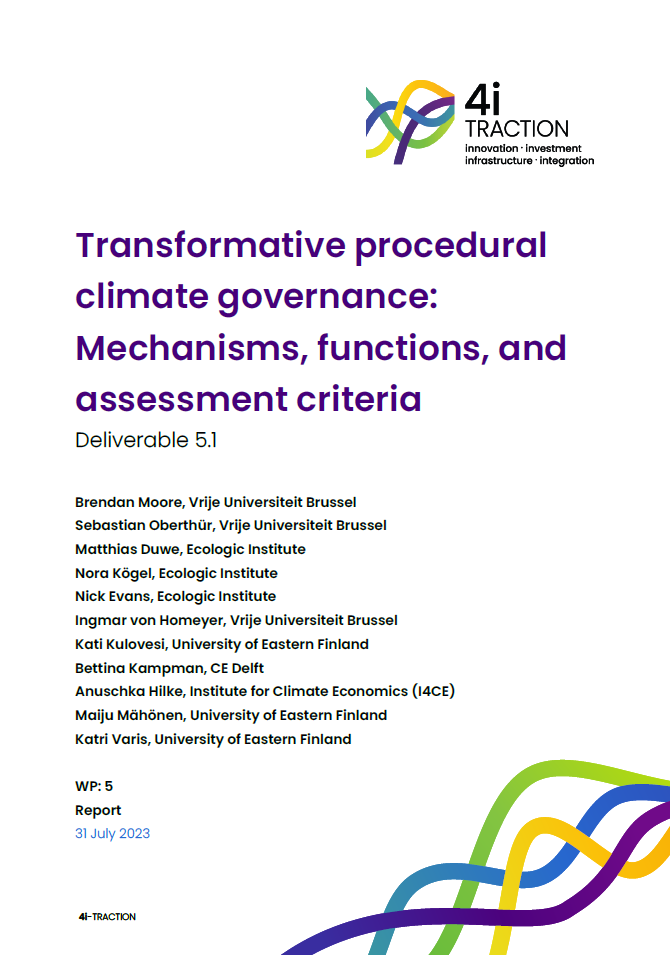
Moore, Brendan, Sebastian Oberthür, Matthias Duwe, Nora Kögel, Nick Evans, Ingmar von Homeyer, Kati Kulovesi, Bettina Kampman, Anuschka Hilke, Maiju Mähönen, and Katri Varis (2023): Transformative procedural climate governance: Mechanisms, functions, and assessment criteria. 4i-TRACTION Deliverable 5.1. Vrije Universiteit Brussel; Brussels.
Meyer-Ohlendorf, Nils et al. (2025): Climate Targets for EU Member States after 2030: Functions and Options. Ecologic Institute, Berlin.
Meyer-Ohlendorf, Nils, et al (2023): EU 2040 climate architecture. Ecologic Institute, Berlin
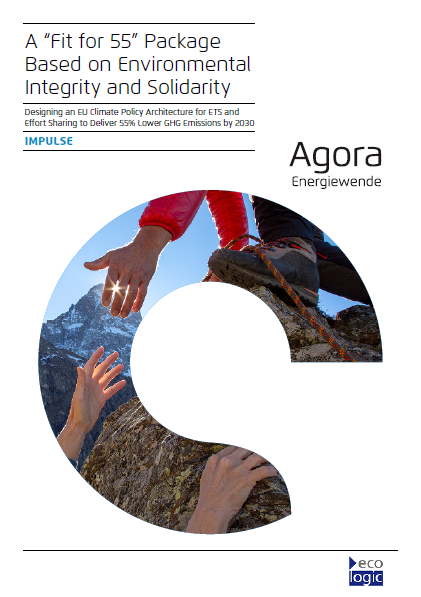
Agora Energiewende and Ecologic Institute (2021): A "Fit for 55" package based on environmental integrity and solidarity: Designing an EU climate policy architecture for ETS and effort sharing to deliver 55% lower GHG emissions by 2030, Berlin: Agora Energiewende.
Kögel, Nora; Velten, Eike; Martini, Leon (2024): EU 2040 Climate Target: Contributions of the industry sector. Ecologic Institute, Berlin.
.jpg)
Meyer-Ohlendorf, Nils, et al. (2025): EU Policies and Measures to Incentivise Carbon Removals. Ecologic Institute, Berlin.