This paper examines the penalty provisions in the draft Czech implementing law submitted on 11 November 2025 by the Minister for the Environment to the Prime Minister. It briefly considers the draft's legislative status in light of the political situation following the 3–4 October general election, assesses its compliance with the EU-MER, and compares it with good practice in Denmark and with Italy's draft law.
This paper examines the penalty provisions in the draft Romanian implementing law proposed by the Romanian government on 22 July 2025. It briefly considers the draft's legislative status, assesses its compliance with EU-MER, and compares it with good practice in Denmark and with Italy's draft law.
Myanmar is a global biodiversity hotspot, home to over 570 freshwater fish species and many endemics. Yet its rivers face mounting pressure from pollution, land-use change and declining water quality. This study co-authored by Ecologic Institute's Dr. Benjamin Kupilas offers novel insights into how tropical fish communities respond to these stresses.
On 4 December 2025, Ecologic Institute co-hosted a closed-door workshop in Brussels with DG CLIMA and the World Economic Forum. As part of the EU-Commission funded project Strategy for the Financing of Permanent Carbon Removals, more than 50 representatives from industry, finance, and EU institutions explored how to accelerate private purchases of high-quality permanent carbon removals (CDR). Early corporate purchasers highlighted three drivers: demonstrating climate leadership, meeting voluntary net-zero targets, and positioning themselves for emerging business opportunities in permanent removals. Participants pointed to high costs, reputational concerns, complex contracting, and policy uncertainty as key obstacles. Many stressed the need for clearer long-term EU policy to give companies confidence to buy early.
After giving a concise overview of the penalty provisions in the EU Methane Regulation (EU-MER), this paper counters the scaremongering narrative promoted by fossil energy groups that the EU-MER creates "unmanageable liability" for EU fossil-fuel importers through fines of up to 20% of annual turnover.
A competitive, clean, and fair EU economy depends on smarter governance practices. This paper proposes eight priority actions for simpler, leaner, and more performance-oriented transition governance in the EU.
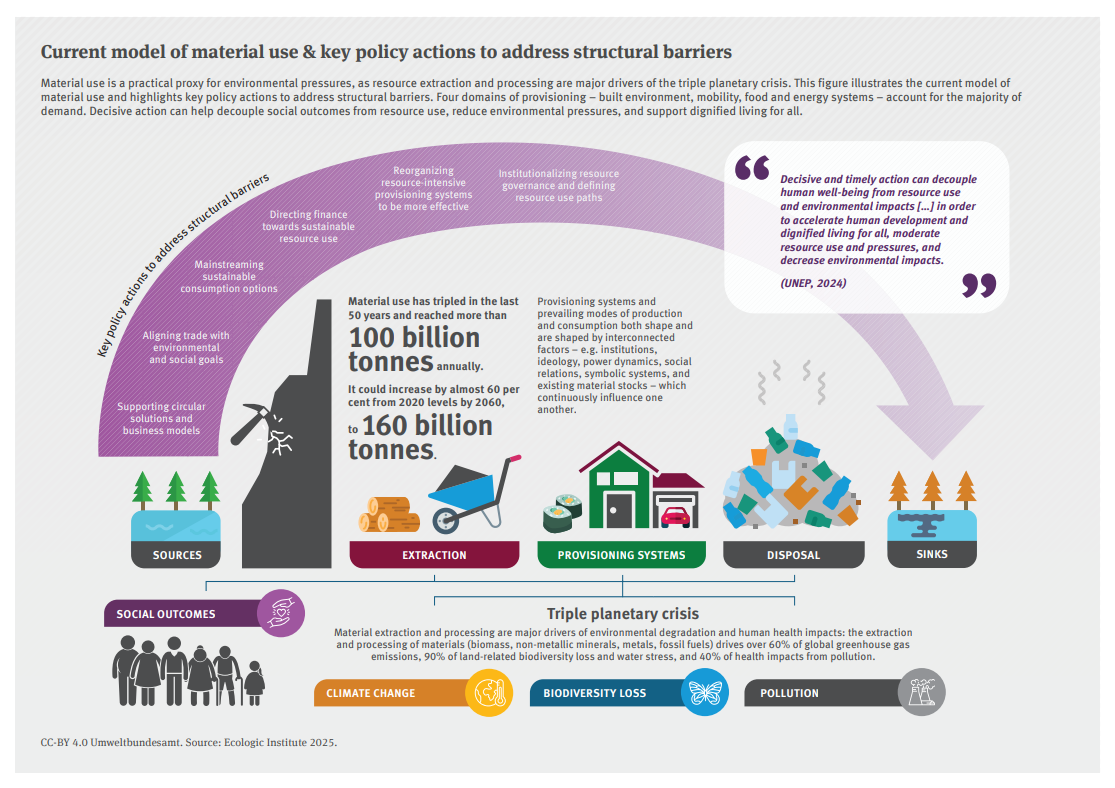
This infographic presents the current model of material use and shows how extraction, production, consumption and disposal drive environmental pressures. It also outlines key policy actions to overcome structural barriers, reduce resource use and decouple human well-being from environmental harm. It is based on the report “Moving from Interconnected Crises to Systemic Solutions. Resource Efficiency, Nature-based Solutions, and Systemic Transformation as Responses to the Complexity of the Triple Planetary Crisis” and highlights concrete pathways for action. The infographic is also included in the accompanying fact sheet under the same title.
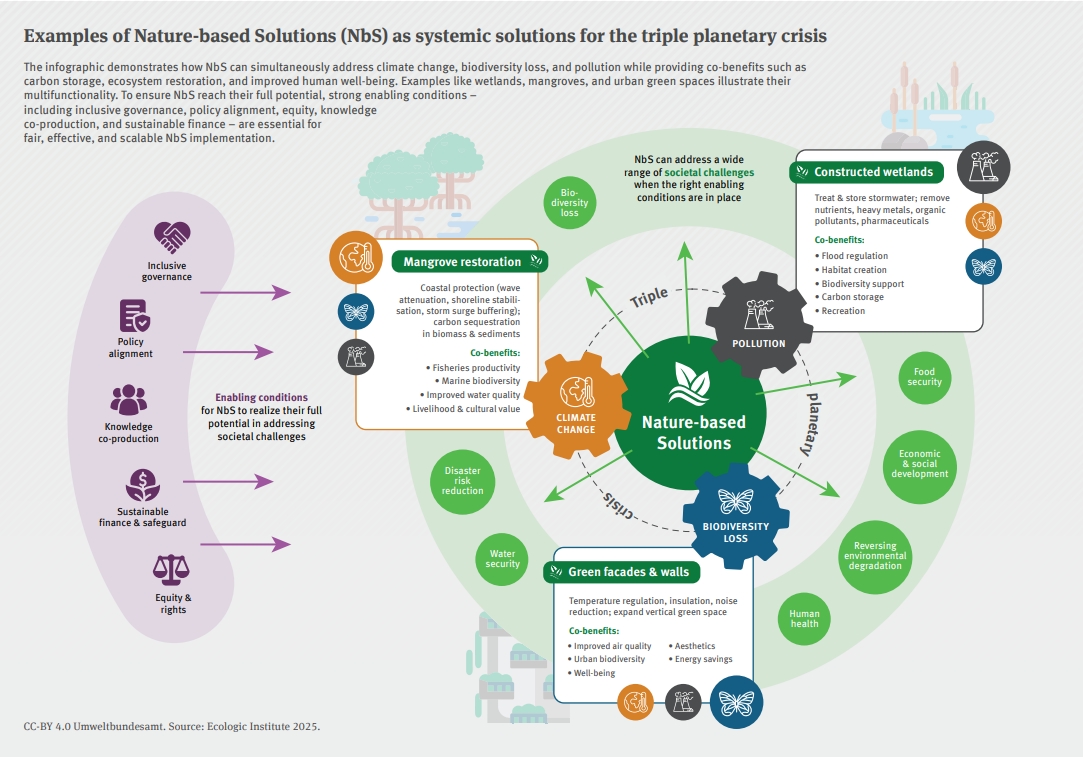
This solution-oriented infographic showcases nature-based solutions (NbS) as systemic responses to the triple planetary crisis, illustrating how measures such as wetland restoration, mangrove protection or urban green infrastructure can simultaneously address climate change, biodiversity loss and pollution, while delivering co-benefits for health, resilience and livelihoods.
Nature-based solutions (NbS) can address multiple dimensions of the triple planetary crisis at once: climate change, biodiversity loss, and environmental pollution, while delivering benefits for people and ecosystems. This infographic, visualises how NbS can function as systemic responses when designed and implemented under the right conditions. It illustrates how measures such as mangrove restoration, constructed wetlands, and urban green infrastructure can simultaneously contribute to climate mitigation and adaptation, strengthen biodiversity, and reduce pollution-related pressures. It also highlights the broader societal challenges that NbS can support, including water and food security, human health, risk reduction, and reversing environmental degradation.
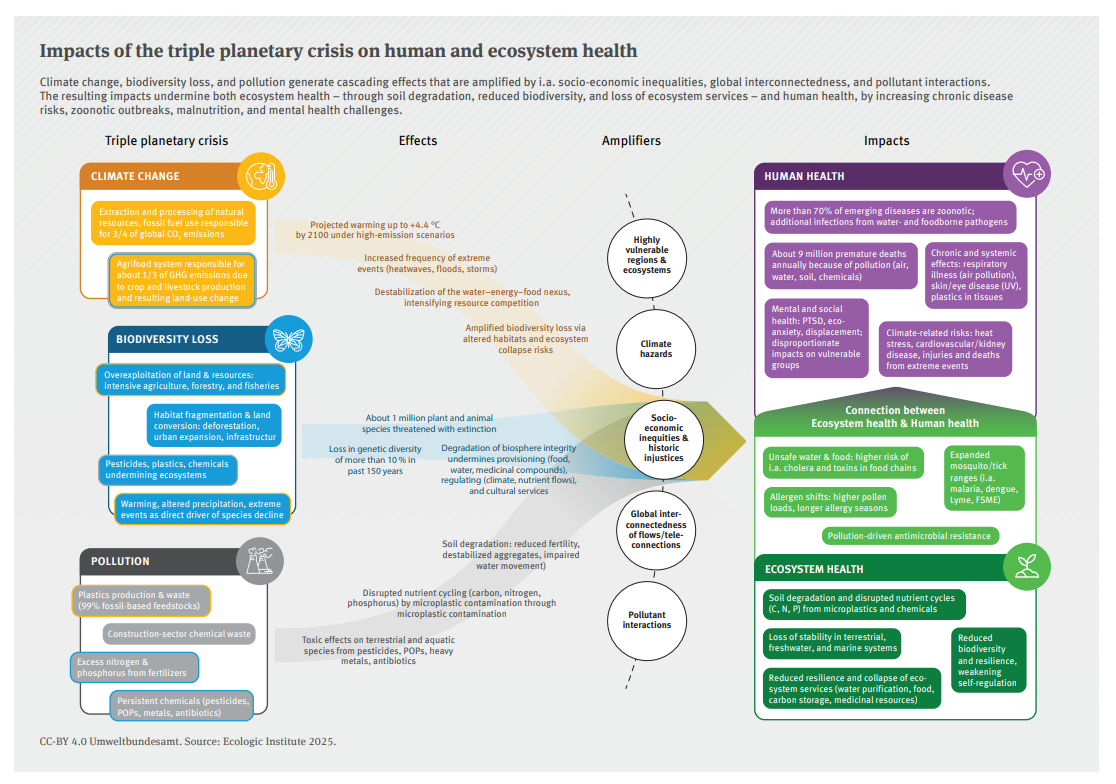
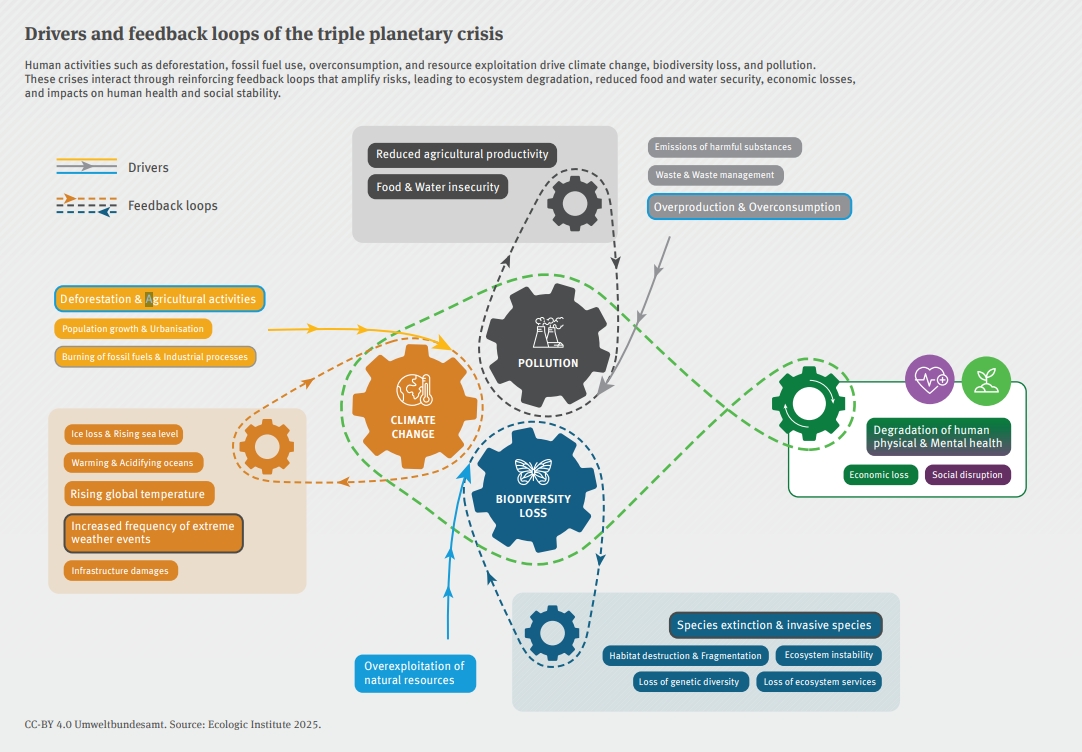
Climate change, biodiversity loss and environmental pollution are deeply interconnected and reinforce one another. This infographic, based on the report "The Interconnected Challenges of Climate Change, Biodiversity Loss and Environmental Pollution: Drivers, Interdependencies and Impacts of the Triple Planetary Crisis", illustrates the main human-driven causes of the triple planetary crisis and the feedback loops that intensify its impacts.
The fact sheet explains why climate change, biodiversity loss and environmental pollution must be understood as a systemically interconnected crisis driven by shared pressures such as resource use, land-use change and structural inequalities. It highlights how direct and indirect drivers interact across sectors and regions, creating reinforcing feedbacks and compounding risks for ecosystems and societies.
Humanity has already exceeded six of the nine planetary boundaries, with climate change, biodiversity loss, and pollution pushing the Earth system beyond its safe operating space. Because these boundaries interact through complex feedback loops, surpassing one accelerates pressures on the others, creating cascading effects that amplify environmental degradation. This interconnected dynamic is driving a systemic triple planetary crisis, or polycrisis, that undermines ecological resilience and threatens long-term human well-being. Addressing it requires integrated, cross-sectoral approaches that tackle shared drivers and deliver co-benefits across environmental and socio-economic domains.
The triple planetary crisis is a systemic challenge, not three separate issues: climate change, biodiversity loss, and pollution reinforce one another through shared drivers and feedback, threatening planetary and human well-being. It is driven by fossil fuel dependence, unsustainable production and consumption, overexploitation of land and resources, and structural inequalities. The analysis concludes that the triple crisis can only be effectively addressed through systemic, cross-sectoral, and justice-oriented approaches. By linking resource governance, NbS, and transformative change, this report highlights how today’s triple crisis can be turned into an opportunity to regenerate ecosystems, reduce inequalities, and build resilient societies within planetary boundaries.
This fact sheet summarizes the information contained in the publication Burgos Cuevas et al. (2025): Moving from interconnected crises to systemic solutions. Resource efficiency, nature-based solutions, and systemic transformation as responses to the complexity of the triple planetary crisis. Interim report, Climate Change 83/2025. German Environment Agency: Dessau-Roßlau. https://doi.org/10.60810/openumwelt-8108.