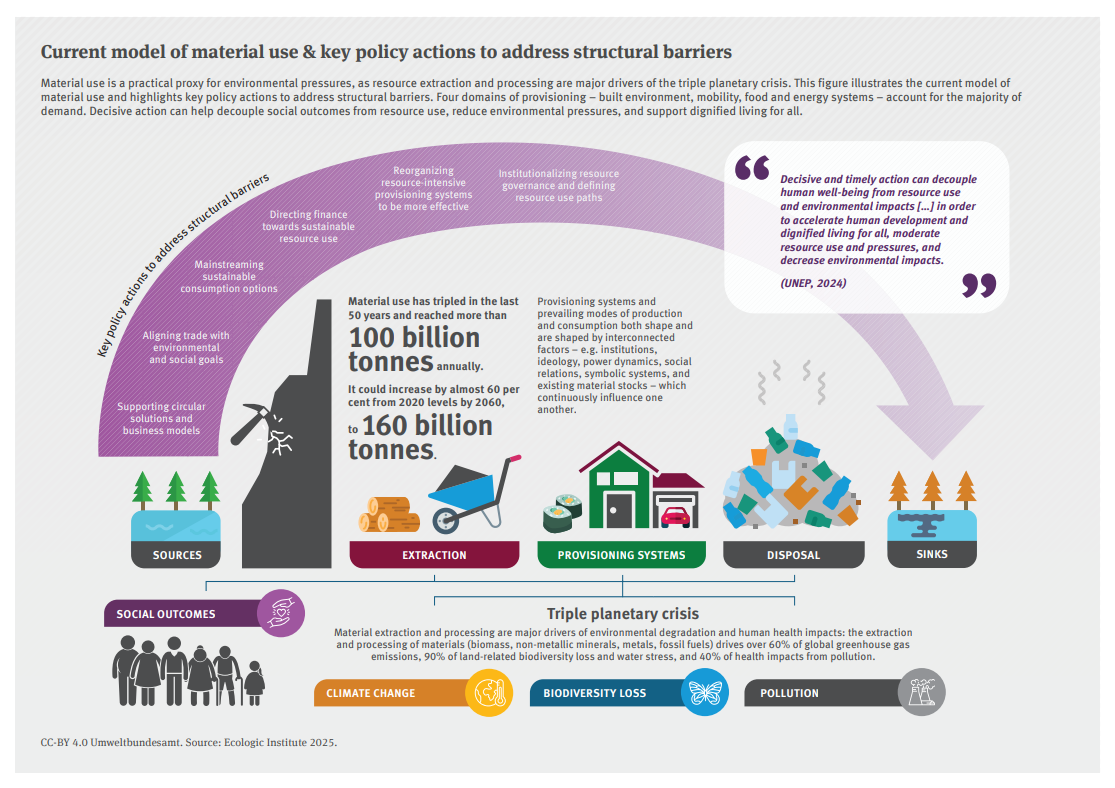
This infographic presents the current model of material use and shows how extraction, production, consumption and disposal drive environmental pressures. It also outlines key policy actions to overcome structural barriers, reduce resource use and decouple human well-being from environmental harm. It is based on the report “Moving from Interconnected Crises to Systemic Solutions. Resource Efficiency, Nature-based Solutions, and Systemic Transformation as Responses to the Complexity of the Triple Planetary Crisis” and highlights concrete pathways for action. The infographic is also included in the accompanying fact sheet under the same title.
This fact sheet summarizes the information contained in the publication Burgos Cuevas et al. (2025): Moving from interconnected crises to systemic solutions. Resource efficiency, nature-based solutions, and systemic transformation as responses to the complexity of the triple planetary crisis. Interim report, Climate Change 83/2025. German Environment Agency: Dessau-Roßlau. https://doi.org/10.60810/openumwelt-8108.
The triple planetary crisis is a systemic challenge, not three separate issues: climate change, biodiversity loss, and pollution reinforce one another through shared drivers and feedback, threatening planetary and human well-being. It is driven by fossil fuel dependence, unsustainable production and consumption, overexploitation of land and resources, and structural inequalities. The analysis concludes that the triple crisis can only be effectively addressed through systemic, cross-sectoral, and justice-oriented approaches. By linking resource governance, NbS, and transformative change, this report highlights how today’s triple crisis can be turned into an opportunity to regenerate ecosystems, reduce inequalities, and build resilient societies within planetary boundaries.
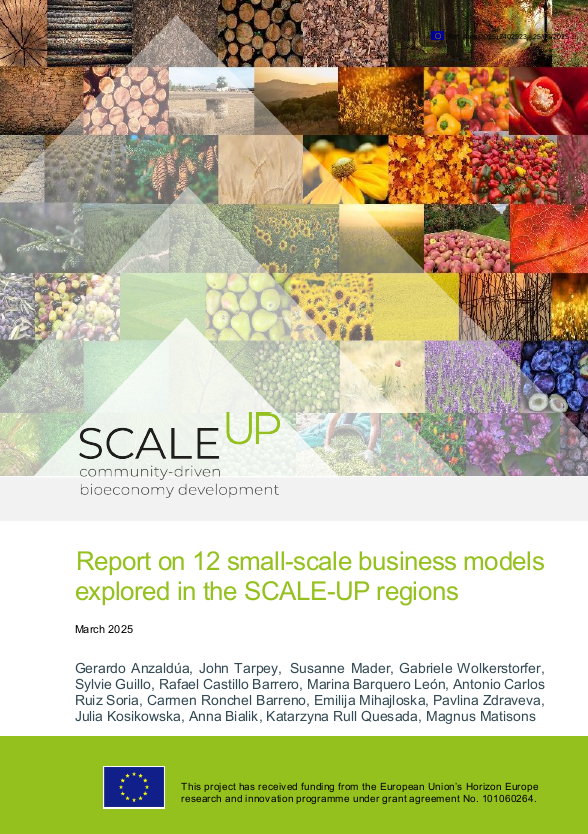
The Report on Regional Biomass Availabilities, Nutrient Balances and Ecological Boundaries was produced under the EU‐funded SCALE-UP project, which seeks to accelerate community‐driven bioeconomy development across six European regions: Northern Sweden, Mazovia (Poland), the French Atlantic Arc, Upper Austria, Andalusia (Spain), and Strumica (North Macedonia).
The bioeconomy concept presents an attractive framework for policymakers in Europe, as it holds the potential to foster innovations that match specific community needs with regionally available resources. The SCALE-UP project aims to enhance the capacity and expertise of multi-actor partnerships to accelerate the development of market-ready bio-based products and services while facilitating their successful market deployment. Additionally, SCALE-UP strengthens collaboration among primary producers, SMEs, industry clusters, social actors, and policymakers, promoting a cohesive approach to innovation.
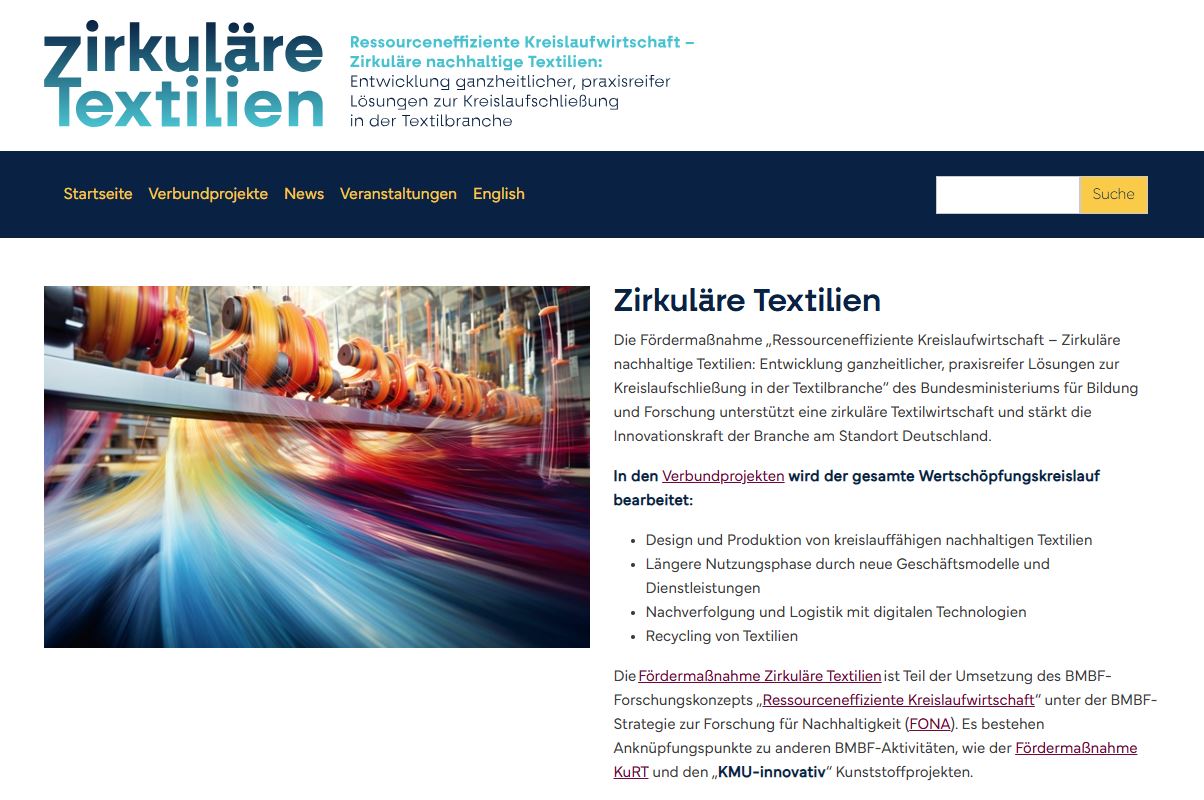
Ecologic Institute designed and developed the project website "Circular Textiles" within the networking and transfer project of the funding program "Resource-efficient circular economy – circular sustainable textiles: development of holistic, practical solutions for closing loops in the textile industry". The website provides an overview of all funded joint projects. It also contains information on the projects and events, as well as news from the networking and transfer project.
This policy brief outlines recommendations for sustainable and socially accepted subsoil management in Germany. Subsoil, located below the plowed topsoil layer, holds essential nutrients and water reserves crucial for plant growth and sustainable bioeconomy practices. The Soil³ project (2015–2025) investigated methods to enhance subsoil usage, focusing on increasing plant root access to this layer without compromising its ecological functions.
This report analyzes documents and formats focusing on resource efficiency, resource conservation and the circular economy at the German, European and international level. It outlines significant developments and expected trends in resource policy and identifies research needs. Given the rapid increase in global resource use, driven by population growth and economic expansion, the transition to a resource-efficient and circular economy is a key challenge. This need is reinforced by various global crises such as climate change, biodiversity loss, pollution and increasing resource dependency. The report emphasizes that innovative and effective policies are needed at both national and international levels to promote and implement this transition.
This final report provides an analysis of the innovation and dissemination processes of infrastructure solutions that aim to increase sustainability and resilience. The research was conducted as part of the TRAFIS II project.
In this episode of "Green Deal – Big Deal?", we tackle the complex world of natural resources, a topic that underpins many aspects of Europe's ambition for a green future. In conversation with guests Florika Fink-Hooijer, Director-General of European Commission’s DG Environment, and Janez Potočnik, Co-chair of the International Resources Panel, hosts Ewa Iwaszuk and Aaron Best discuss how the use of natural resources is closely linked to the climate and biodiversity crises, highlighting the global nature of resource use and its impacts.
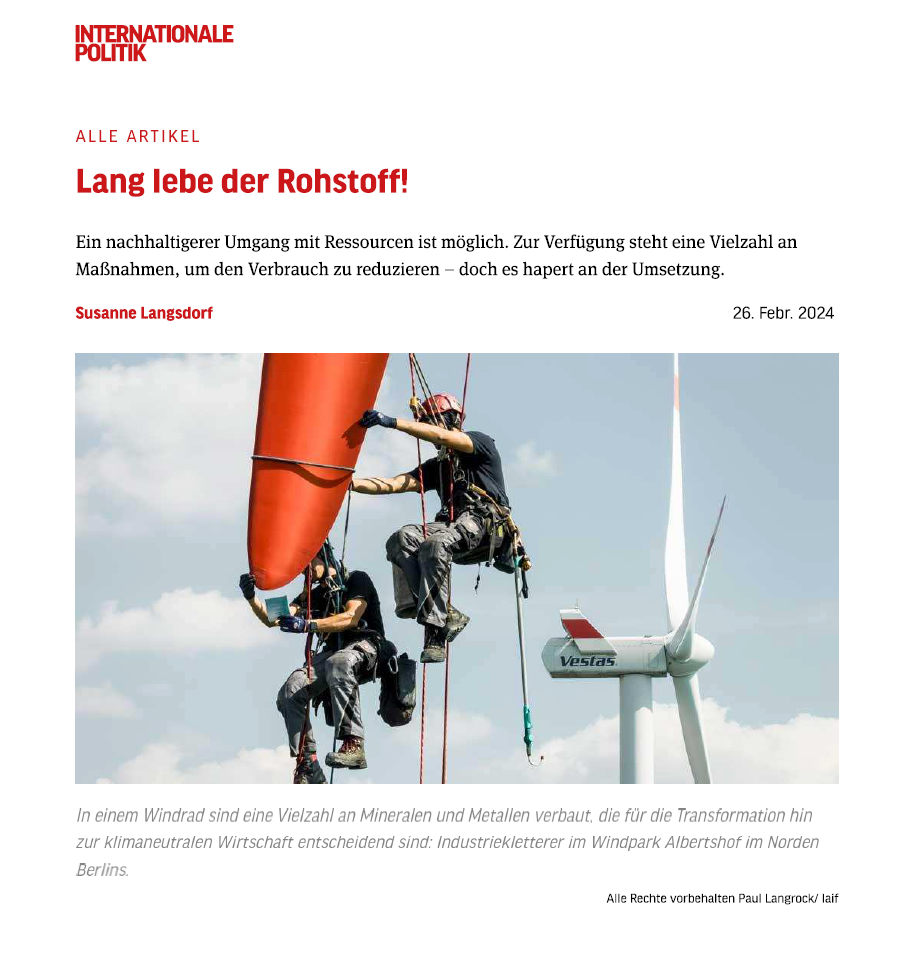
In the article "Lang lebe der Rohstoff" (available in German), Susanne Langsdorf provides an overview of Germany's use of raw materials, its dependence on sometimes problematic trading partners and what tools Germany has to reduce this.
A more sustainable use of resources is possible. There is a wide range of measures available to reduce consumption - but there is a lack of implementation.
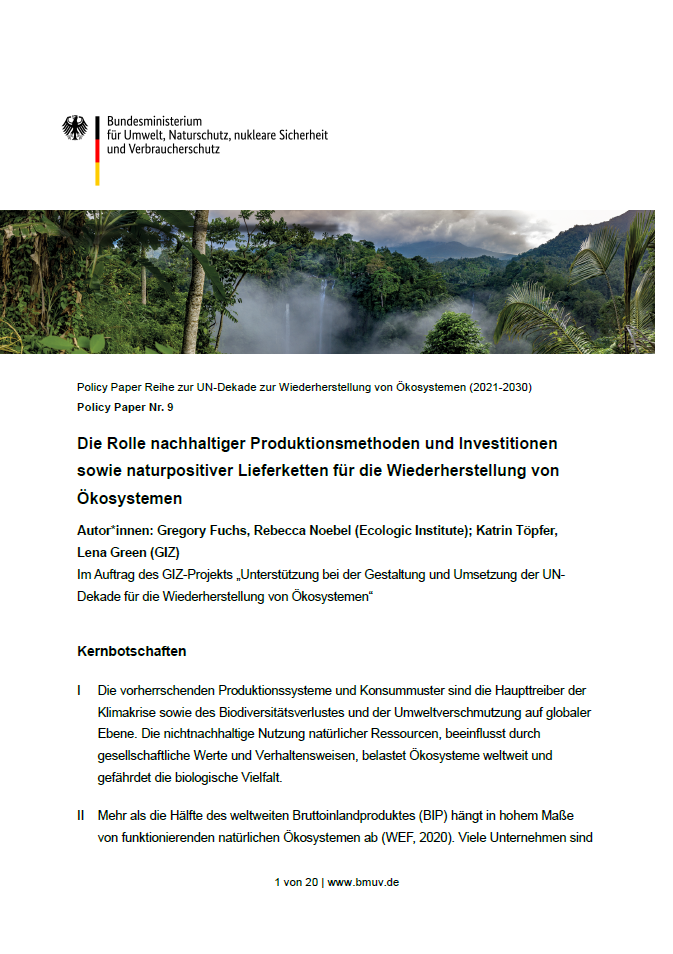
How can companies and societies effectively design the shift towards greater sustainability? This policy brief highlights the importance of sustainable production methods, investments, and nature-positive supply chains for the restoration of ecosystems and outlines action approaches for a sustainable future.
This report provides an independent, systematic analysis of the structures, activities, and impacts of Germany’s Energy, Climate, Development, and Raw Materials Partnerships (ECDRPs). A particular focus lies on the partnerships with countries of the Global South. Based on the analysis, the report provides recommendations for the development of Germany’s partnerships by answering the central question: How can Germany's ECDRPs be made as impactful as possible and more transformative for a resilient transition towards climate neutrality in Germany and its partner countries?
This report analyzes how innovative, sustainable infrastructure solutions can be successfully disseminated through specific mechanisms and under certain conditions. It emphasizes the importance of cooperative networks and suitable framework conditions for the dissemination of innovations at municipal and regional level.
Der Bericht wurde im Rahmen des EU‐geförderten SCALE‐UP‐Projekts erstellt, um zwölf innovative biobasierte Vorhaben zu identifizieren, die in sechs ländlichen Regionen Europas wirtschaftliche, ökologische und soziale Vorteile bieten können: Nordschweden; Masowien (Polen); der französische Atlantikbogen; Oberösterreich; Andalusien (Spanien); und Strumica (Nordmazedonien).
The evaluation of the municipal networks for the period 2018 to 2021 is now published and available for download. 28 projects were funded with Euro 5.66 million, and municipalities contributed almost Euro 3.8 Mio. own revenue for the networking activities. Over the evaluation period, the networks contributed to a reduction in greenhouse gas emissions of 69.2 thousand tonnes of CO2.
This article illustrates the communication strategies that were successfully applied in the citizen science program Plastic Pirates in Germany. The program engages schoolchildren, teachers and youth groups in plastic pollution research. A variety of communication strategies have been implemented and continuously revised and adapted since the start of the program in 2016.
This publication provides a quantitative overview of the development and status of environmental crime in Germany between 2010 and 2020, with a supplementary presentation for the year 2021, based on data from the police crime statistics ("Polizeiliche Kriminalstatistik"), as well as statistics from the Federal Statistical Office's criminal prosecution ("Strafverfolgungsstatistik"). The report provides both an overview of general trends and an in-depth account of individual environmental offences. Additionally, the publication contains data on administrative offences relating to the trafficking of protected species. The report was prepared by a team from Ecologic Institute on behalf of the German Federal Environment Agency.
This report analyses how a circular economy can contribute to halting biodiversity loss. It concludes that while circular economy measures (directly and indirectly) contribute to meeting biodiversity and climate strategic objectives, the combination with biodiversity-friendly sourcing is crucial in order to halt biodiversity loss.
This paper addresses a gap by providing a conceptual basis to further the understanding of security implications of the EU’s transformation to a net-zero economy. It first defines the aspects of security under consideration (Section 2) and proposes a typology to classify fossil fuel exporting countries based on their exposure to world market prices, their capacity to adjust and their importance to the EU in terms of security issues (Section 3). It then takes stock of policy options that can be adopted in other countries to reduce adjustment costs to a changed economic environment (Section 4) and discusses how the EU can support these policies (Section 5). Finally, it highlights key implications for EU policy makers (Section 6).
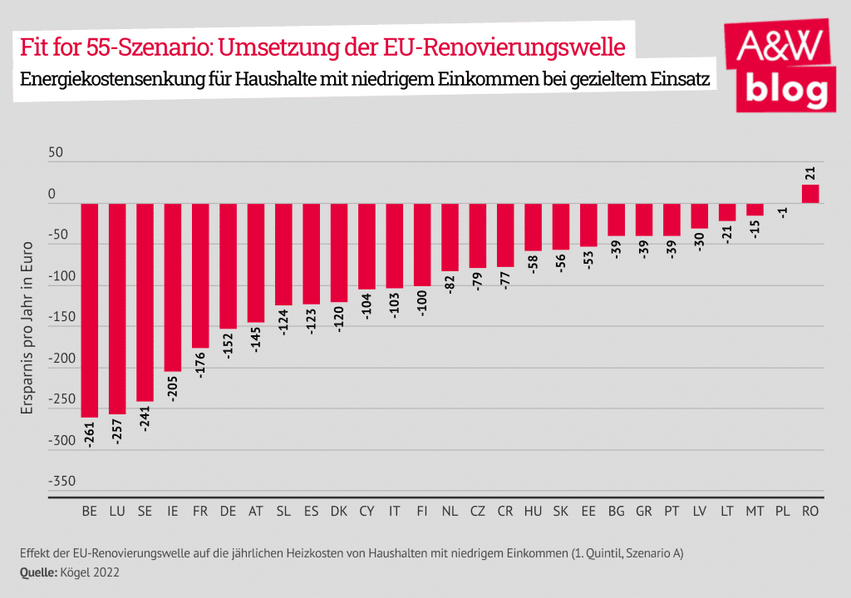
This blog post shows why the EU Renovation Wave should link environmental and social issues. EU member states are currently facing three crises: the climate crisis, an energy security crisis and a social crisis. The EU Renovation Wave has a key role in responding to all three crises. However, it can only fulfill this key role if the implementation of the renovation wave is socially fair.
Almost one third of all packaging in Germany is so-called transport packaging, which becomes waste after its single use. Despite the factual relevance of this packaging group, it is strongly underrepresented in the public perception as well as in the political discourse. During the online expert dialogue "Reusable Transport Packaging" on 27 February 2023, good examples from practice were presented and potentials, challenges and necessary elements for the expansion of reusable transport packaging were discussed together with experts from trade, logistics industry, civil society and politics. The summary is available for download.
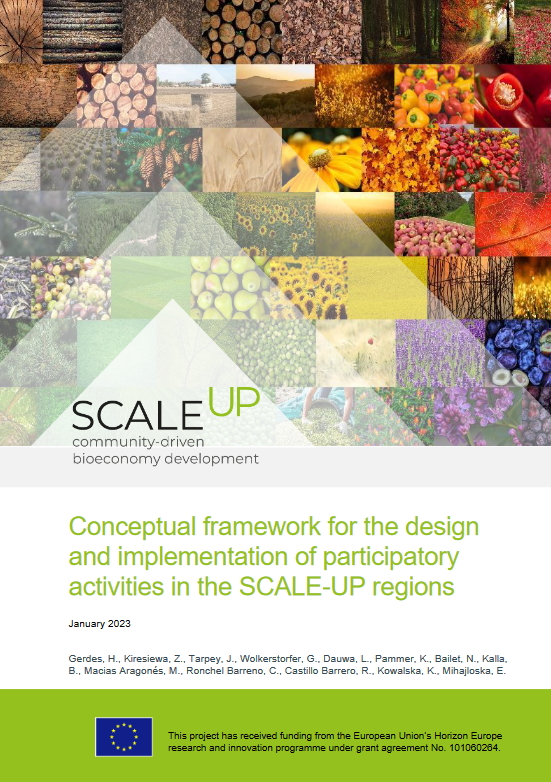
This framework sets out a holistic approach to foster community-driven bioeconomy development across six rural European areas. Building on a four-phase methodology – establishing regional knowledge and platforms; cross-regional knowledge transfer; creation of a pan-European Community of Practice; and dissemination – the report aligns with the European Green Deal and the second pillar of the Common Agricultural Policy (CAP). It identifies relevant biomass streams (from sawdust and agricultural residues to hemp and olive by-products) and outlines valorization options that drive local innovation while respecting ecological limits.
To tackle the "plastic crisis", the concept of circular economy has attracted considerable attention over the past years, both by practitioners and scholars alike. Against this background, Linda Mederake, Ecologic Institute, reflects in this opinion paper from a political scientist's point of view on key issues currently under discussion regarding the implementation of a circular plastics economy.
In December 2022, the 6th European Resources Forum – "Transformative approaches for sustainable resource use and a circular economy" took place. Aaron Best of Ecologic Institute supported the German Environment Agency in content-related issues surrounding the Forum, including the preparation of this background paper.
The transition to sustainable resource use and a circular economy is broadly recognised as an important lever in dealing with the various current crises. Debates in various international organisations suggest that such a transition will require profound systemic changes and the increased integration of previously separated policy fields in order to deliver the expected benefits. Moreover, current efforts are largely focused on entire product value chains.
There is a clear need for sustainable resource use to confront the multiple environmental crises while allowing societies to thrive. Governments around the world seek to establish systematic policies towards the implementation of sustainable resource use and a circular economy. In the session "Sustainable Resource Use and Circular Economy – the Social Dimension" we take a closer look at how these developments affect the social aspects of sustainability. What implications can changing resource use patterns in Europe have for well-being, development, prosperity and health, especially in the global South? How can an inter- and intragenerational just resource use be achieved and what are the stumbling blocks?
In December 2022, the 6th European Resources Forum – "Transformative approaches for sustainable resource use and a circular economy" took place. Dr. Aissa Rechlin of Ecologic Institute supported the German Environment Agency in content-related issues surrounding the Forum, including the preparation of this background paper.
This analysis shows that there is considerable potential in Germany to facilitate, stimulate, and ultimately increase the use of recycled materials through political regulation and incentivization. It provides recommendations for a successful policy mix to increase the use of recyclates.
In light of current experiences in energy markets, Western democracies, and the EU in particular, are exploring new supply chains and strategies to reduce their raw material dependence on China. The findings presented here by the authors of this study provide an overview of the main options that the EU can currently use to counter the pressures of growing dependencies. This study discusses some positive examples of feasible circular approaches that aim to achieve savings in the use of rare earths.
A democratic dialogue with a broad spectrum of stakeholders and the society is considered necessary for the transformation to a sustainable bio-based economy. As such, several dedicated bioeconomy strategies across Europe and beyond outline objectives towards broader stakeholder and public engagement. In this book chapter Zoritza Kiresiewa, Laurens Duin and Holger Gerdes address the degree of participation and the role of the individual actor groups and society in strategy development processes and recommend concrete actions for more inclusive and effective stakeholder and public engagement.
This study presents innovative processes and technologies of the circular economy. The case studies come from a range of industries that are of particular importance to Hesse and demonstrate the broad applicability of the technologies presented. The case studies are split into five main groups, each containing a few innovative and sustainable projects by various institutions and firms. They also offer insights into the economic and ecological advantages of the projects and provide the readers with a thorough understanding of the processes.
This report provides the context and justification for the development of BE-Rural's Sustainability Screening, a description of its methodological procedure, and the syntheses of results from the two experimental implementations of the approach in the Stara Zagora and Vidzeme regions, which are included in full as annexes to this report. The last chapters present the main lessons learned from these two pilots and the overall conclusions of the task.
For the project, "Green Deal – Big Deal? Discussing Europe's Green Future", Ecologic Institute designed a postcard series. The postcard series promotes the podcast itself and on two cards in particular the third episode Sustainability in Style: Circular fashion in the European Green Deal. The postcards are designed according to the project's style guidelines and also include a QR code to the podcast (episode).
The BE-Rural Evaluation Report takes stock of the project's work to promote bioeconomy strategies in Europe's rural regions. Co-authored by Ecologic Institute's scientists Zoritza Kiresiewa, Holger Gerdes, and Gerardo Anzaldúa, the report reflects on achievements, challenges, and lessons learned.
In March 2022, at the resumed fifth meeting of the United Nations Environment Assembly, UN Member States adopted the historic decision to start negotiating a global treaty to combat plastic pollution. As national delegations and relevant stakeholders in Asia start preparing for the upcoming negotiations, this report by Linda Mederake and Doris Knoblauch (both Ecologic Institute), aims to provide an analysis of the region’s opportunities to end single-use plastics (SUPs) pollution through the development of this new global treaty.