The European Union has introduced detailed certification rules for permanent carbon removals for the first time, laying important groundwork for their future integration into EU climate policy. However, key provisions remain legally contested. This policy brief examines the requirements of the new regulation and explores its potential implications for European climate policy.
This report assesses how far the Czech authorities have implemented Regulation (EU) 2024/1787 on the reduction of methane emissions in the energy sector (EU-MER) on the basis of publicly available information and information obtained directly from Czech authorities and companies.
Seagrass meadows, seabed sediments, mussel reefs and macroalgal forests can take up and retain carbon. But how much of that carbon remains sequestered over the long term? This scientific literature review examines carbon retention and sequestration across four marine habitats in the North Sea and Baltic Sea. It identifies the processes that determine whether carbon is stored permanently, highlights substantial knowledge gaps and explores the implications for nature-based climate mitigation.
This guide shows how municipalities can systematically identify, assess and compare the costs and NbS. It takes users through a stepwise process on how to go about assessing costs and benefits. Documentation tables and guiding questions help apply each step to a specific project.
How do electricity supply, infrastructure, industry and a fair distribution of costs need to work together for the energy transition to succeed? The final report, “The Grand Challenges of the Energy Transition”, brings together findings from six years of research under the Ariadne Kopernikus project.
As part of the TrueFoodS project, Ecologic Institute led a comparative legal and policy analysis of nine CAP Strategic Plans (CSPs), through which Member States define their agricultural priorities and planned support measures for 2023–2027. Using a common analytical framework covering eight post-harvest stages and five sustainability dimensions, the assessment examined the extent to which post-harvest activities are reflected in strategic priorities and supported through planned CAP interventions.
More green spaces and trees can help nature thrive in cities. But how much they actually contribute to biodiversity depends on their ecological quality, how well they are connected and how they are managed over the long term. This discussion paper identifies the conditions cities need to develop and maintain high-quality urban nature.
How can sustainability be firmly embedded in the education of medical and pharmaceutical professionals? A research article in the International Journal of Sustainability in Higher Education explores this question in the German context. The authors identify structural barriers that currently hinder the systematic integration of sustainability and present a political roadmap for higher education, vocational training and continuing professional development.
The European Climate Neutrality Observatory (ECNO) has published the second 2026 edition of its Clean Industrial Transition Monitor Quarterly Bulletin. The publication tracks economic developments affecting European industry alongside the implementation and expected impact of key initiatives under the EU’s Clean Industrial Deal.
A policy brief from Ariadne, a Kopernikus project funded by the German Federal Ministry of Research, Technology and Space, sets out why Germany and the EU should maintain ambitious climate policies and examines the instruments and formats through which they can promote climate action internationally while safeguarding domestic efforts.
The data and charts in this brief update those presented in our January 2026 paper: Europe's Selective Blindness on Gas: US LNG and the Limits of Supply Diversification. This brief draws on the most recent (2 July 2026) version of Bruegel’s European natural gas imports dataset, covering the first half of 2026.
This ACCREU policy brief sets out a research agenda for the economics of transformational adaptation, identifying where established approaches can contribute and where new or extended methods are needed.
The EU’s Carbon Removals and Carbon Farming (CRCF) Regulation has established a framework for the certification of carbon farming. Yet credible certificates alone will not create demand. In an article published in Ökologisches Wirtschaften, Aaron Scheid of Ecologic Institute explains why binding climate targets for the agricultural sector are also needed.
A new policy paper by Ecologic Institute examines how the EU can better integrate climate, economic, and social governance frameworks for the clean transition. It finds that important links already exist, but differences in timing, reporting, and political priorities often prevent them from working effectively.
Although pharmaceuticals are indispensable for public healthcare, their environmental impacts are rarely considered during prescribing or dispensing. A newly developed Environmental Pharmaceutical Index (EPI) aims to integrate environmental information systematically into pharmaceutical and medical decision-making. The objective is to balance therapeutical needs and environmental impacts by supporting the selection of therapeutically equivalent medicines with lower environmental impacts without compromising patient care.
Geopolitical tensions, volatile energy markets and the focus on strategic autonomy have pushed industrial competitiveness to the top of the political agenda. European climate policy therefore requires close coordination between emissions reduction, investment security and competitiveness. In a background paper, Ariadne researchers summarise how governance, financing, industrial transformation, the EU Emissions Trading Scheme and energy infrastructure need to simultaneously ensure decarbonisation, economic resilience and public support.
How should economics assess adaptation when responding to climate change, which may require fundamental changes to economies and societies rather than incremental adjustments? This ACCREU technical report examines this emerging research field and identifies eight priorities for developing the economics of transformational adaptation.
The brief links these findings to concrete recommendations for implementing Regulation (EC) No 1107/2009 more effectively. These include updating EFSA guidance and the data requirements under Regulations (EU) No 283/2013 and 284/2013, expanding the use of sensitive species and endpoints, improving assessments of pesticide mixtures and environmental fate, and better integrating non-dietary exposure and vulnerable life stages into regulatory testing. Many of these improvements could therefore be introduced within the existing EU approval framework.
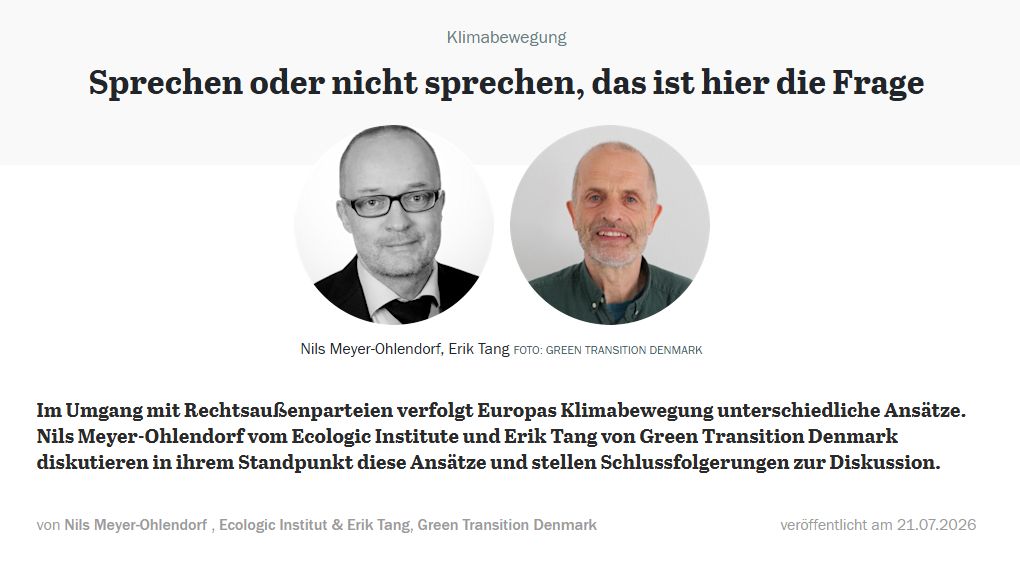
Europe’s climate movement has adopted different approaches to engaging with far-right parties. In this Tagesspiegel opinion piece, Nils Meyer-Ohlendorf of the Ecologic Institute and Erik Tang of Green Transition Denmark discuss these approaches and draw conclusions. The views expressed are solely those of the authors.
Published as a Comment in Nature Reviews Biodiversity in 2026, the article "Implementation of the EU Nature Restoration Regulation requires a shift from restoration targets to restoration landscapes" explores the next phase of implementing the EU Nature Restoration Regulation. Daniel Hering, Benjamin Kupilas and Rafaela Schinegger argue that achieving the Regulation's ambitious objectives now requires a shift from setting restoration targets to developing spatially coordinated restoration landscapes, supported by effective governance, strategic spatial planning, sustainable financing and strong stakeholder engagement.
ECNO’s 2026 State of EU Progress to Climate Neutrality report provides a comprehensive assessment of whether the European Union is moving quickly enough to meet its climate goals. Drawing on a broad set of indicators and policy analysis, the report evaluates progress across the economy and identifies where stronger implementation could reduce exposure to fossil fuel dependence, supply-chain vulnerabilities, affordability challenges and climate-related risks.
The white paper brings together evidence and recommendations from seven EU-funded projects, including RESTORE4Cs. The paper highlights the urgent need to accelerate wetland conservation and restoration across Europe, as degraded wetlands continue to drive biodiversity loss, weaken water resilience, and turn ecosystems that can store carbon into sources of greenhouse gas emissions.
The paper assesses four policy options for integrating Article 6 credits into the EU ETS through a central intermediary rather than allowing companies to purchase credits directly. It argues that this indirect approach would provide greater oversight of credit quality and supply, helping to preserve the EU ETS's role in driving domestic emissions reductions while offering limited flexibility where appropriate.
The European Commission’s proposed Omnibus Simplification Package aims to streamline the authorisation of pesticides and reduce regulatory burdens within the European Union. However, a new Policy Forum article published in Science argues that the proposal could significantly weaken environmental risk assessment procedures and increase risks to biodiversity and human health. According to the authors, the current EU pesticide framework already contains important gaps, including insufficient consideration of impacts on many non-target organisms, cumulative effects of multiple pesticides, and sublethal ecological impacts. Rather than addressing these shortcomings, the Omnibus proposal may exacerbate them.
This report examines the penalty provisions contained in the revised Draft Emergency Ordinance (DEO) proposed by the Romanian government in April 2026 to implement the EU Methane Emissions Regulation (EUMR).
How can Europe finance large-scale ecosystem restoration at a time of growing pressure on public budgets?
A new Biodiversa+ policy brief explores how well-designed Public-Private Partnerships (PPPs) can help mobilise private investment while safeguarding ecological integrity and delivering long-term societal benefits. Building on the EU Nature Restoration Regulation, the brief outlines practical recommendations to create investment-ready restoration projects, strengthen public-private collaboration, and establish the policy conditions needed to scale up private financing for nature restoration across Europe.
This paper argues that there is no plausible basis for the introduction of a “grace period” in respect of infringements of Article 27 of the EU Methane Emissions Regulation (EUMR), as proposed in a recently leaked draft European Commission Recommendation.
Researchers at Ecologic Institute have developed a new tool to help governments to produce socially just climate adaptation strategies. The Just2Adapt tool allows the user to analyse the justice dimensions of Heat Action Plans at the strategic level as well as at the level of individual measures. It is important that heat adaptation strategies integrate social justice considerations because of the unequal way in which the heat-health effects of climate change are distributed across the population.
This study develops a proposal for a comprehensive revision of the German Federal Soil Protection Act (Bundes-Bodenschutzgesetz, BBodSchG) and presents a fully drafted legislative text.
MEER:STARK provides practical recommendations and an integrated framework for strengthening the resilience of the North Sea and Baltic Sea to climate-related impacts. The project demonstrates that effective marine conservation and climate adaptation should be addressed jointly rather than as separate policy domains. By linking ecological restoration, adaptive governance, nature-based solutions, and participatory management approaches, the project offers a foundation for developing more coherent and resilient marine policies in the future.
In this article Dr. Stephan Sina provides an overview of the key provisions of the Directive, with a focus on water protection offences, and examines, based on the planned implementation in Germany, the extent to which the Directive facilitates the prosecution of water crime. This is also of interest to Switzerland, as the Council of Europe Convention on the Protection of the Environment through Crime Law, adopted in 2025, is modelled on the Directive.
As the European Union considers to reform its Emissions Trading System (EU ETS) by integrating permanent carbon dioxide removals (CDR), this report examines safeguards to support the gradual scale-up of permanent removals whilst keeping their quantity under control to manage risks and ensure incentives for reducing emissions remain
Mangroves, coral reefs and other coastal ecosystems can play a crucial role in reducing climate-related risks while supporting biodiversity and local livelihoods. A new discussion paper reviews the current state of Ecosystem-based Adaptation (EbA) in tropical coastal regions and explores financing instruments that can help scale up and sustain coastal resilience measures over the long term.
A new Roundtable published by The Nature of Cities asks a central question for the planning and implementation of nature-based solutions: whose voices shape decisions, and who remains unheard? Curated by McKenna Davis of Ecologic Institute and Natalia Andrea Burgos Cuevas of the IUCN, the Roundtable brings together 29 contributors from around the world to reflect on what meaningful inclusion, co-creation and environmental justice can look like in practice.
In light of the agreed expansion of European emissions trading (inter alia the gradual inclusion of maritime transport and the introduction of the EU ETS 2), the study contains an analysis of the current sanctions regime in emissions trading. The fundamental amendment to the TEHG brought about by the TEHG EU Alignment Act 2024 has already been taken into account. Proposals for a more effective sanctions regime are put forward, relating both the enforcement of existing regulations and reforms of these regulations. The study focuses on administrative offence law.