This guide shows how municipalities can systematically identify, assess and compare the costs and NbS. It takes users through a stepwise process on how to go about assessing costs and benefits. Documentation tables and guiding questions help apply each step to a specific project.
More green spaces and trees can help nature thrive in cities. But how much they actually contribute to biodiversity depends on their ecological quality, how well they are connected and how they are managed over the long term. This discussion paper identifies the conditions cities need to develop and maintain high-quality urban nature.
The brief links these findings to concrete recommendations for implementing Regulation (EC) No 1107/2009 more effectively. These include updating EFSA guidance and the data requirements under Regulations (EU) No 283/2013 and 284/2013, expanding the use of sensitive species and endpoints, improving assessments of pesticide mixtures and environmental fate, and better integrating non-dietary exposure and vulnerable life stages into regulatory testing. Many of these improvements could therefore be introduced within the existing EU approval framework.
Published as a Comment in Nature Reviews Biodiversity in 2026, the article "Implementation of the EU Nature Restoration Regulation requires a shift from restoration targets to restoration landscapes" explores the next phase of implementing the EU Nature Restoration Regulation. Daniel Hering, Benjamin Kupilas and Rafaela Schinegger argue that achieving the Regulation's ambitious objectives now requires a shift from setting restoration targets to developing spatially coordinated restoration landscapes, supported by effective governance, strategic spatial planning, sustainable financing and strong stakeholder engagement.
The European Commission’s proposed Omnibus Simplification Package aims to streamline the authorisation of pesticides and reduce regulatory burdens within the European Union. However, a new Policy Forum article published in Science argues that the proposal could significantly weaken environmental risk assessment procedures and increase risks to biodiversity and human health. According to the authors, the current EU pesticide framework already contains important gaps, including insufficient consideration of impacts on many non-target organisms, cumulative effects of multiple pesticides, and sublethal ecological impacts. Rather than addressing these shortcomings, the Omnibus proposal may exacerbate them.
How can Europe finance large-scale ecosystem restoration at a time of growing pressure on public budgets?
A new Biodiversa+ policy brief explores how well-designed Public-Private Partnerships (PPPs) can help mobilise private investment while safeguarding ecological integrity and delivering long-term societal benefits. Building on the EU Nature Restoration Regulation, the brief outlines practical recommendations to create investment-ready restoration projects, strengthen public-private collaboration, and establish the policy conditions needed to scale up private financing for nature restoration across Europe.
Nature-based solutions (NbS) at the landscape scale are increasingly recognised for their role in supporting biodiversity, enhancing ecological connectivity and contributing to climate change adaptation. However, their assessment and implementation remain complex. This article examines these challenges using the concept of pondscapes – networks of ponds and their surrounding terrestrial habitats – as a case for landscape-scale NbS.
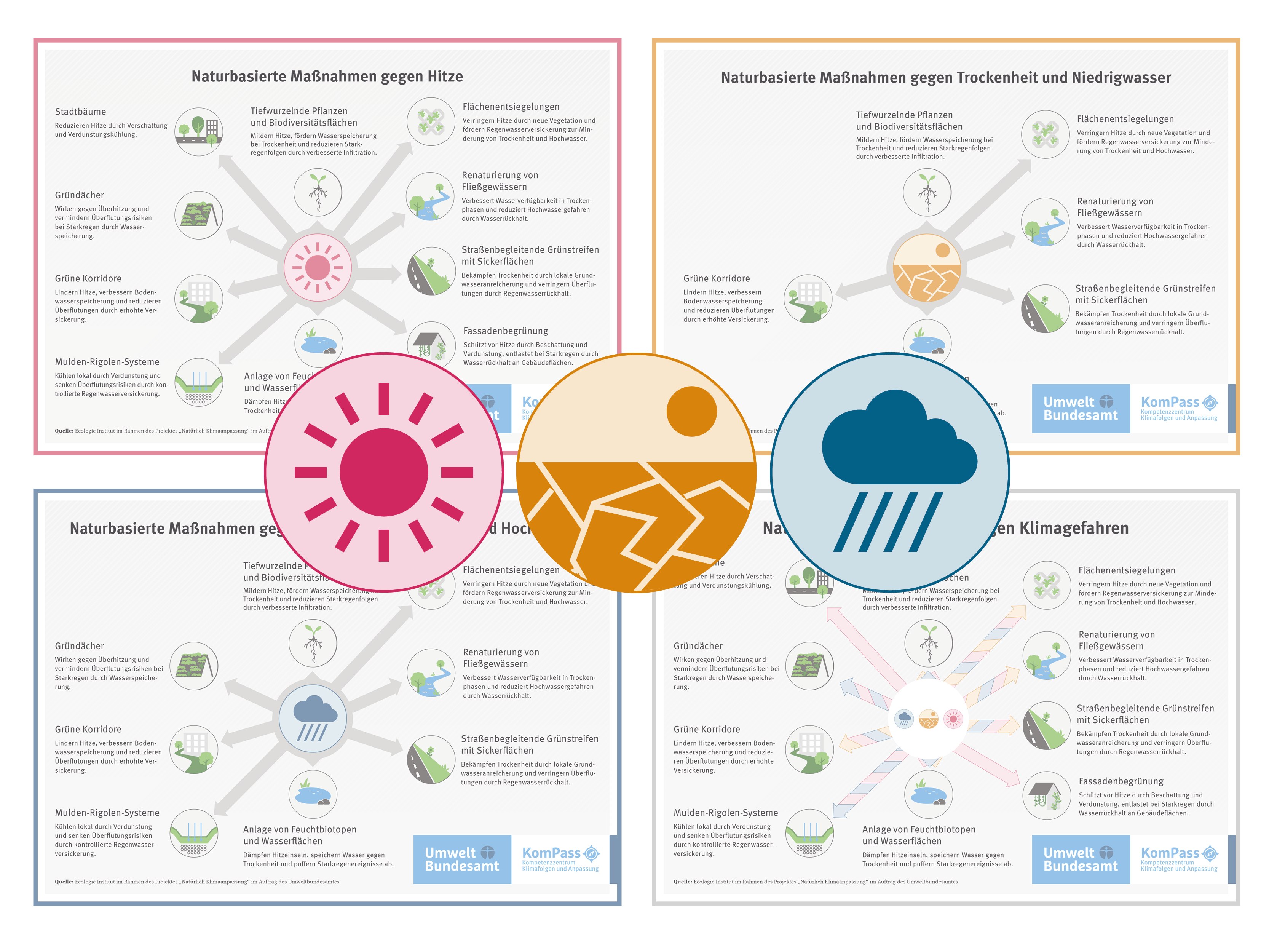
Climate change is affecting cities in various ways: heatwaves are becoming more frequent, flooding is occurring more often, and prolonged periods of drought are putting pressure on water resources. This series of infographics provides an overview of key climate-related risks and shows how nature-based solutions can help mitigate them.
What do shaded paths, green roofs and restored waterways have in common? In many cities, they are already part of the urban landscape – yet often remain unnoticed. This guide, published by the German Environment Agency, focuses on these existing measures. It explains how municipalities can use city maps to make nature-based climate adaptation visible, place it in context and communicate it in a transparent and accessible way.
Nature-based climate adaptation unfolds not only in urban space but also in public perception. Measures such as urban greening, water retention or heat action plans require clear and targeted communication in order to be understood, accepted and supported. A new short guide published by the German Environment Agency outlines how municipalities can use press work strategically to communicate nature-based climate adaptation in a clear and structured way.
Nature-based climate adaptation can only be effective if it reaches the people it is meant to serve. Inclusive public communication plays a key role in this process: it helps ensure that nature-based solutions are not only planned and implemented but also understood, accepted and shaped by a wide range of communities. This guide, published by the German Environment Agency, provides practical guidance on how municipalities can design inclusive communication strategies for nature-based climate adaptation.
This publication provides a quantitative overview of the development and status of environmental crime in Germany between 2013 and 2024, based on data from the police crime statistics ("Polizeiliche Kriminalstatistik") and the Federal Statistical Office's criminal prosecution statistics ("Strafverfolgungsstatistik"). The report provides both an overview of general trends and an in-depth account of individual environmental offences. The report was prepared by a team from Ecologic Institute on behalf of the German Federal Environment Agency.
The aim of the analysis is to assess stormwater management measures not only in terms of their hydraulic performance and costs but also to systematically capture their additional ecological, social and economic benefits.
This policy brief offers recommendations for EU and national policymakers to enable diversified funding for nature restoration. It draws on lessons from four Horizon 2020 projects – MERLIN, REST‑COAST, SUPERB, and WaterLANDS – that together worked across Europe to test how restoration projects can attract broader support and financing.
This report presents a strategic, evidence-based approach to support the upscaling of freshwater restoration and implementation of Nature-based Solutions across Europe. Central to the approach is the MERLIN Upscaling Workflow, a flexible decision-support tool that uses Europe-wide datasets to identify high-impact restoration areas.
This pilot roadmap is designed to support national authorities and stakeholders in Romania in develo ping a strategic framework for planning coastal wetland restoration, for example in the context of National Restora tion Plans. It draws on the latest scientific data, tools and methods developed by the EU-funded project RESTORE4Cs.
This pilot roadmap is designed to support national authorities and stakeholders in Portugal in developing a strategic framework for planning coastal wetland restoration, for example in the context of National Restoration Plans.