Wirkungsvolle Pressearbeit für naturbasierte Klimaanpassung
Ein Kurzleitfaden für Kommunen
- Publication
- Citation
Stüdeli, Lena; Bueb, Benedict (2026): Wirkungsvolle Pressearbeit für naturbasierte Klimaanpassung. Ein Kurzleitfaden für Kommunen. Herausgegeben vom Umweltbundesamt, Fachgebiet I 2.8 – Vorsorgende Umsetzungsstrategien und Instrumente der Klimawandelanpassung, Aktionsprogramm Natürlicher Klimaschutz. Dessau-Roßlau. ISSN 2363-832X.
Nature-based climate adaptation unfolds not only in urban space but also in public perception. Measures such as urban greening, water retention or heat action plans require clear and targeted communication in order to be understood, accepted and supported. A new short guide published by the German Environment Agency outlines how municipalities can use press work strategically to communicate nature-based climate adaptation in a clear and structured way.
Press work as a strategic instrument
The guide approaches press work as a deliberate communication tool rather than a routine activity. It helps municipalities assess whether press outreach is appropriate for a specific message, what objectives can realistically be achieved, and which audiences can be reached. The focus is on the question of when a message is relevant enough for the general public and what criteria determine its news value.
Clear structure, deliberate framing
A core section of the guide focuses on drafting effective press releases. One focus of the guide is on the content design of press releases. It explains the classic structure and introduces the concepts of framing and narrative. It highlights how word choice, perspective and narrative structure shape the perception of topics and which interpretative frameworks are particularly suitable for nature-based climate adaptation. Concrete examples are used to show how positive and problem-oriented frames can be combined in a meaningful way and linked to practical solutions.
Addressing target groups
The guide also emphasises the importance of targeting specific audiences. Different narratives – for example, on health, security, social cohesion or economic efficiency – appeal to different groups. It is crucial to select these narratives carefully and tailor them to the realities of the respective target group's lives without simplifying or distorting the content.
Choosing the right moment
In addition to content and language, timing also plays a key role. The guide provides an overview of suitable occasions for press relations, including themed campaign days, political events and, where appropriate, extreme weather events.
Learning from practice
The guide is supplemented by examples from municipal practice. Selected press releases illustrate how target group communication, framing, timing and news value interact and where there is room for improvement.
Guidance for municipal communication
The short guide is aimed at municipalities of different sizes and levels of experience. It provides structured guidance for those who wish to use press work in a deliberate and reflective way to communicate nature-based climate adaptation and keep the topic visible in public discourse.
The guide was developed as part of the ‘Climate Adaptation Naturally!’ project and is available free of charge as a PDF file.
Contact

- Language
-
German
- Authorship
- Credits
Editing: Dr. Andreas Huck (UBA)
Typesetting and layout: Lena Aebli (Ecologic Institute)- Funding
-
German Environment Agency (UBA), Germany - Published by
-
German Environment Agency (UBA), Germany - Year
- Dimension
- 28 pp.
- ISSN
-
2363-832X
- Project
- Project ID
- Table of contents
-
Click to show full table of contents
- Keywords
-
nature-based solutions planning, climate adaptation tools, urban climate resilience, spatial planning for adaptation, ecosystem-based adaptation measures, municipal climate strategies, climate adaptation implementation, decision-support tools for municipalities, urban resilience planning, climate adaptation guidanceGermany, German municipalities, local authorities, urban areas, cities and towns, municipal level, European context, regional planning, local climate governance, urban regionsstrategic press relations, audience-oriented communication, municipal media relations, news value analysis (newsworthiness), decision logic, decision pathway, timing analysis for press work, occasion-based communication, crisis and event communication, practice-based case analysis, best practice analysis, communication planning, framing, narrative communication, solution-oriented climate communication, positive frames, problem-oriented frames, audience-specific framing, narrative-based knowledge transfer, storytelling in press work, benefit-oriented communication, impact-oriented communication, audience analysis, relevance assessment of messages, media channel analysis, resource assessment, comparative analysis of municipal practice examples, principle of clarity, principle of relevance, contextualisation, practical orientation, reflexive communication practice, evidence-based climate communication
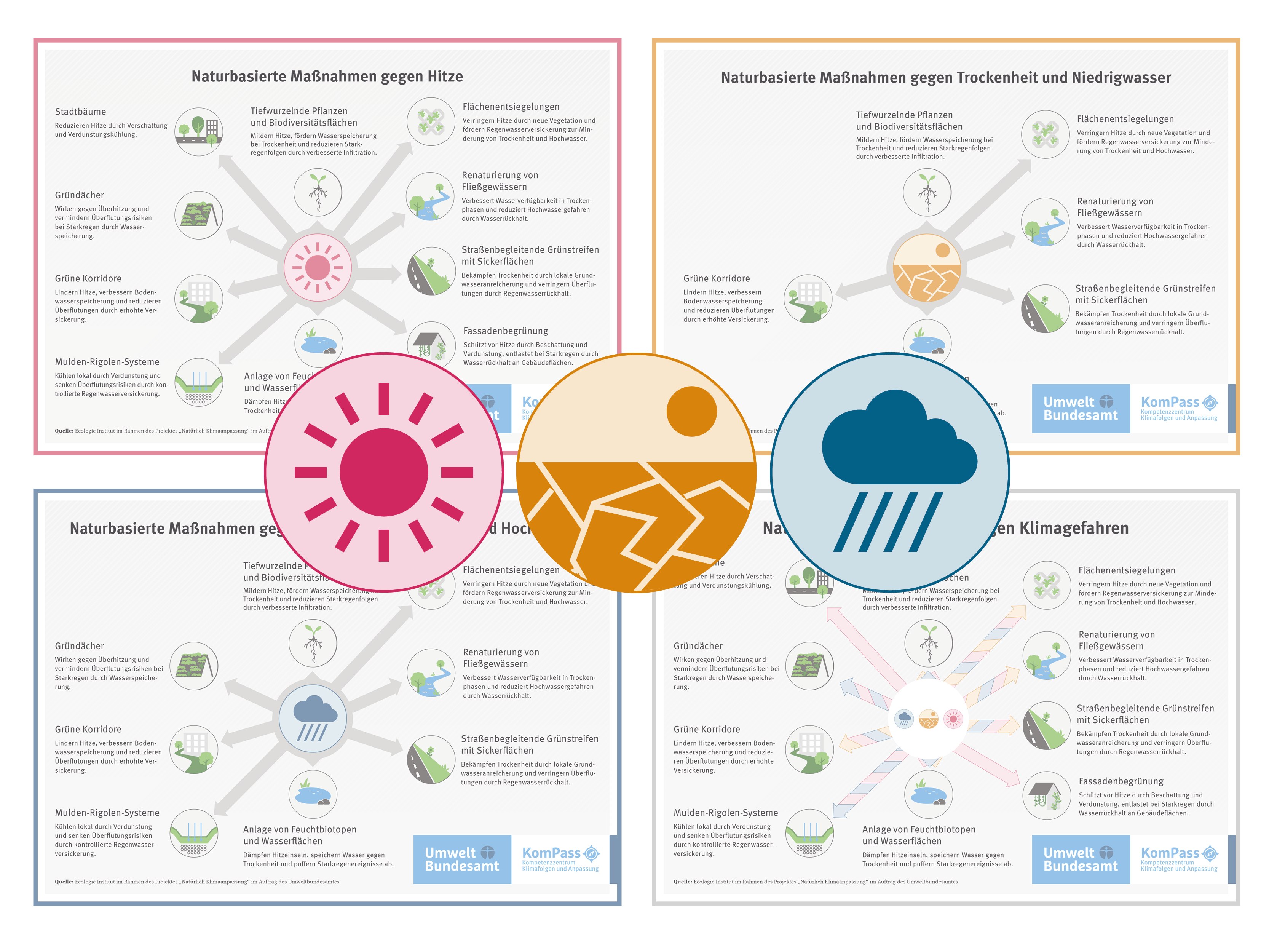
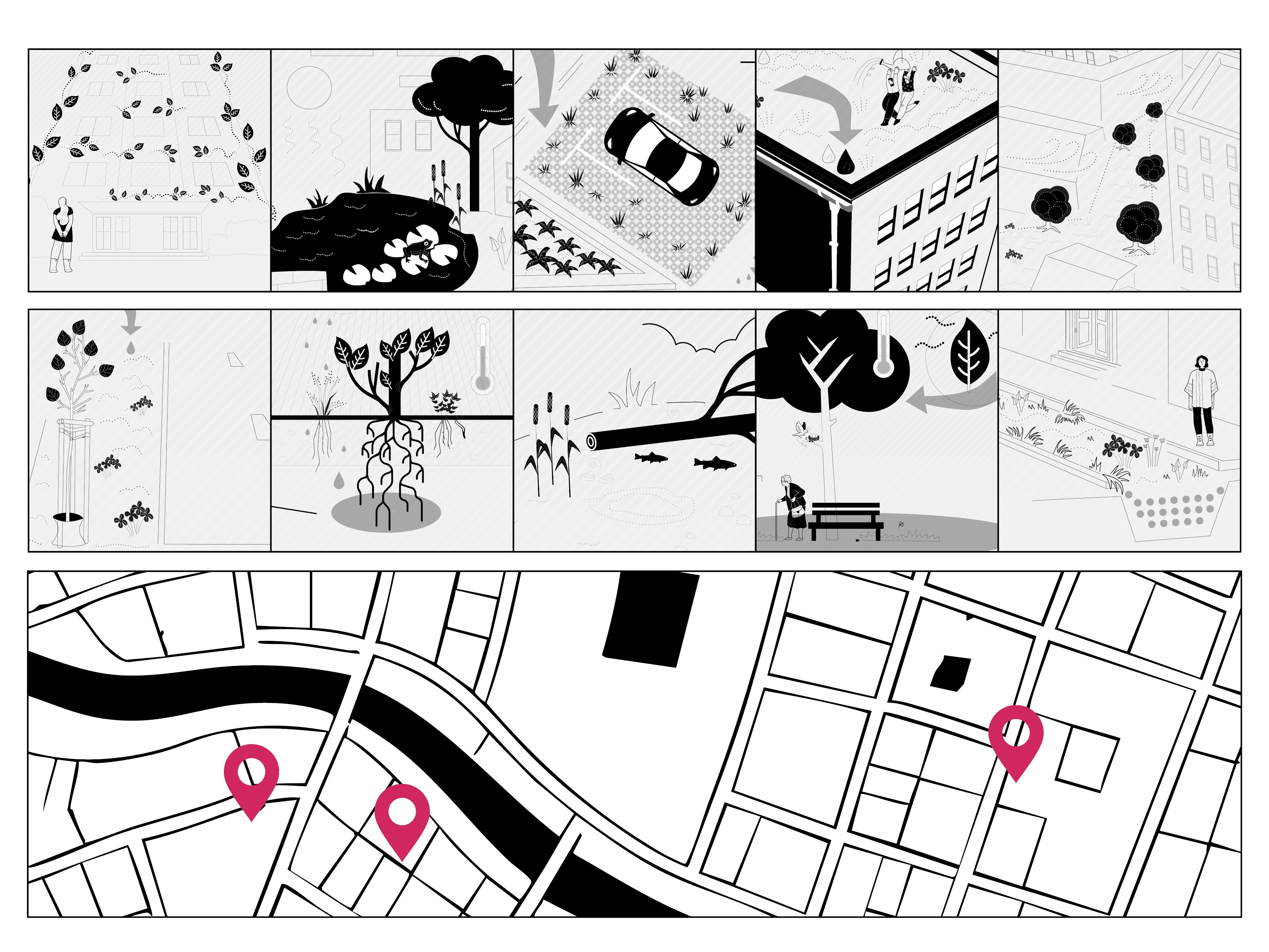
Mederake, Linda; Bueb, Benedict; Felthöfer, Charlotte (2026): Naturbasierte Klimaanpassung mit Stadtkarten. Ein Leitfaden für Kommunen. Herausgegeben vom Umweltbundesamt, Fachgebiet I 2.8 – Vorsorgende Umsetzungsstrategien und Instrumente der Klimawandelanpassung, Aktionsprogramm Natürlicher Klimaschutz. Dessau-Roßlau. ISSN 2363-832X.
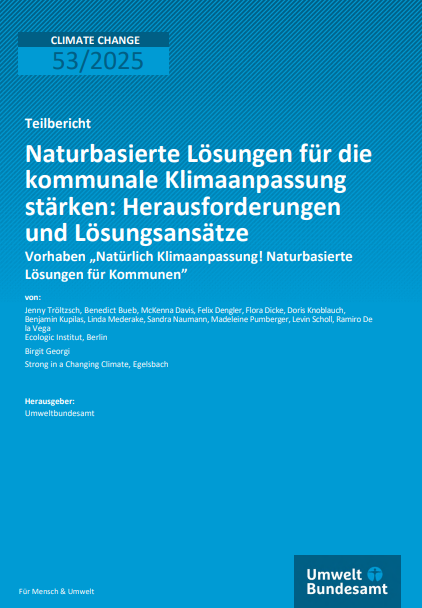
Tröltzsch, J., Bueb, B., Davis, M., Dengler, F., Dicke, F., Knoblauch, D., Kupilas, B., Mederake, L., Naumann, S., Pumberger, M., Scholl, L., De la Vega, R., & Georgi, B. (2025). Naturbasierte Lösungen für die kommunale Klimaanpassung stärken: Herausforderungen und Lösungsansätze. Umweltbundesamt. https://doi.org/10.60810/openumwelt-7902
Dicke, F., Tröltzsch, J., Bueb, B. (2025). Jenseits öffentlicher Gelder: Wie Kommunen naturbasierte Lösungen für die Klimaanpassung finanzieren können. Fact Sheet. Umweltbundesamt: Dessau-Roßlau.
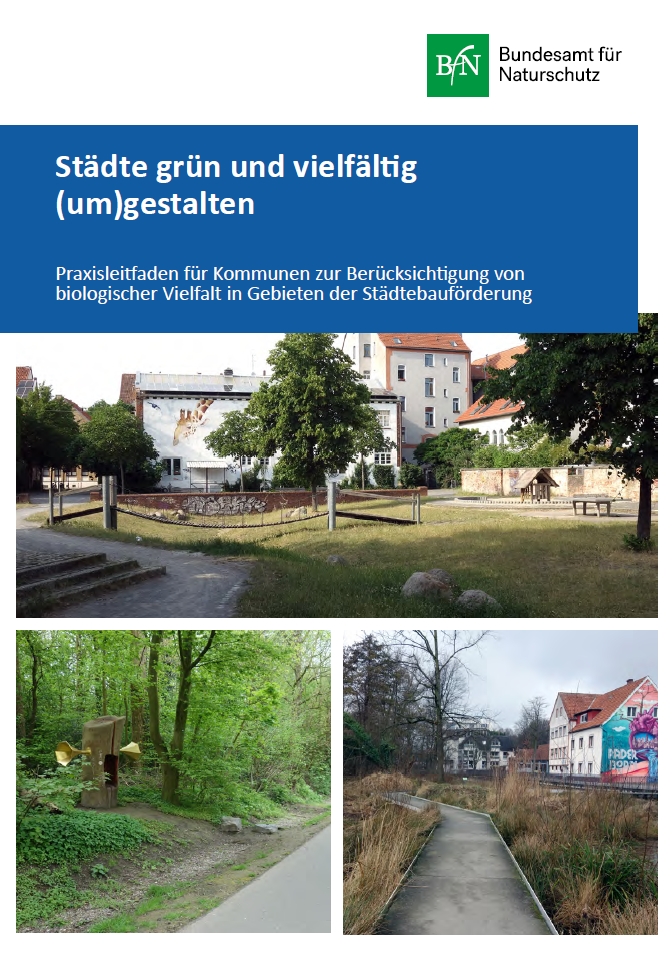
Bundesamt für Naturschutz (Hrsg.) (2024): Städte grün und vielfältig (um)gestalten. Praxisleitfaden für Kommunen zur Berücksichtigung von biologischer Vielfalt in Gebieten der Städtebauförderung. Bonn.
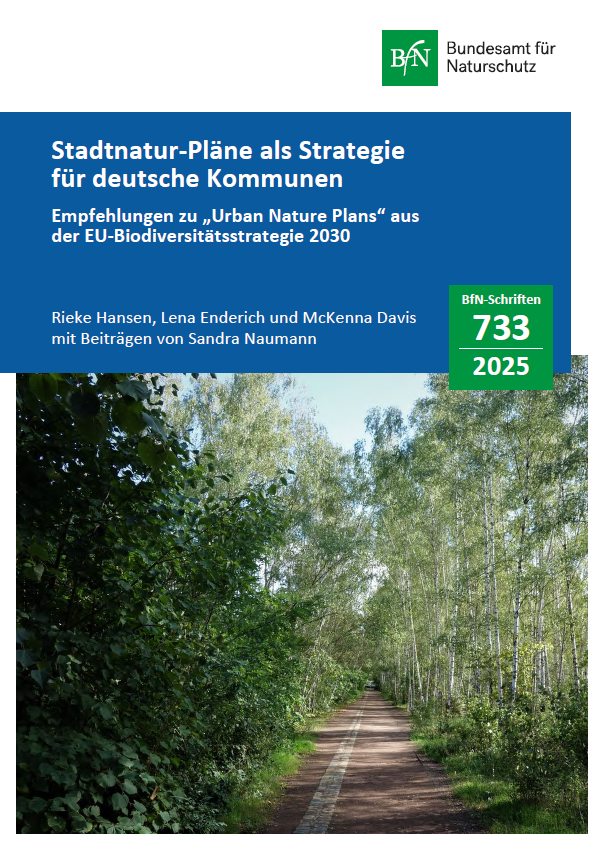
Bundesamt für Naturschutz (ed.) (2025): Stadtnatur-Pläne als Strategie für deutsche Kommunen. Empfehlungen zu "Urban Nature Plans" aus der EU-Biodiversitätsstrategie 2030. Bonn.
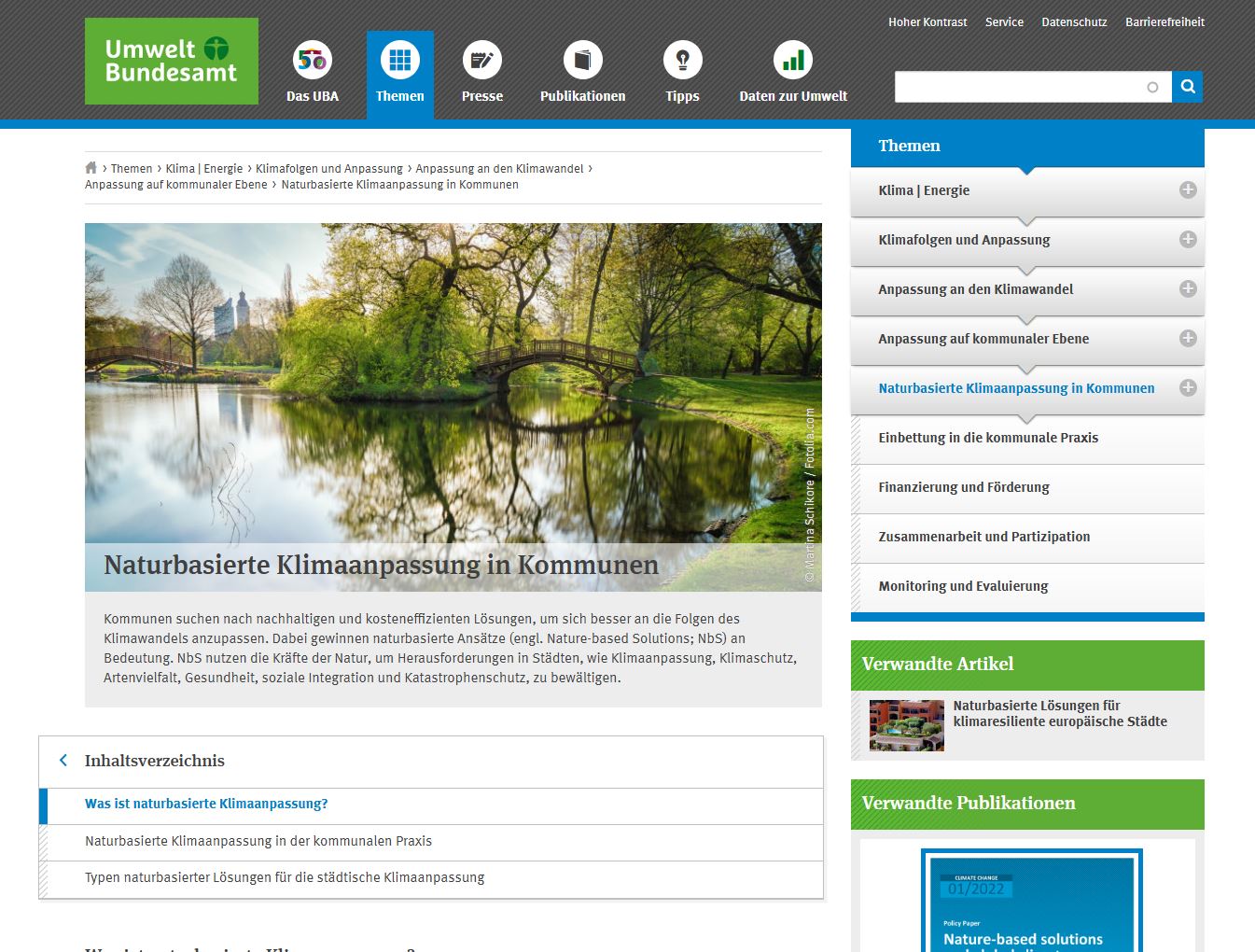
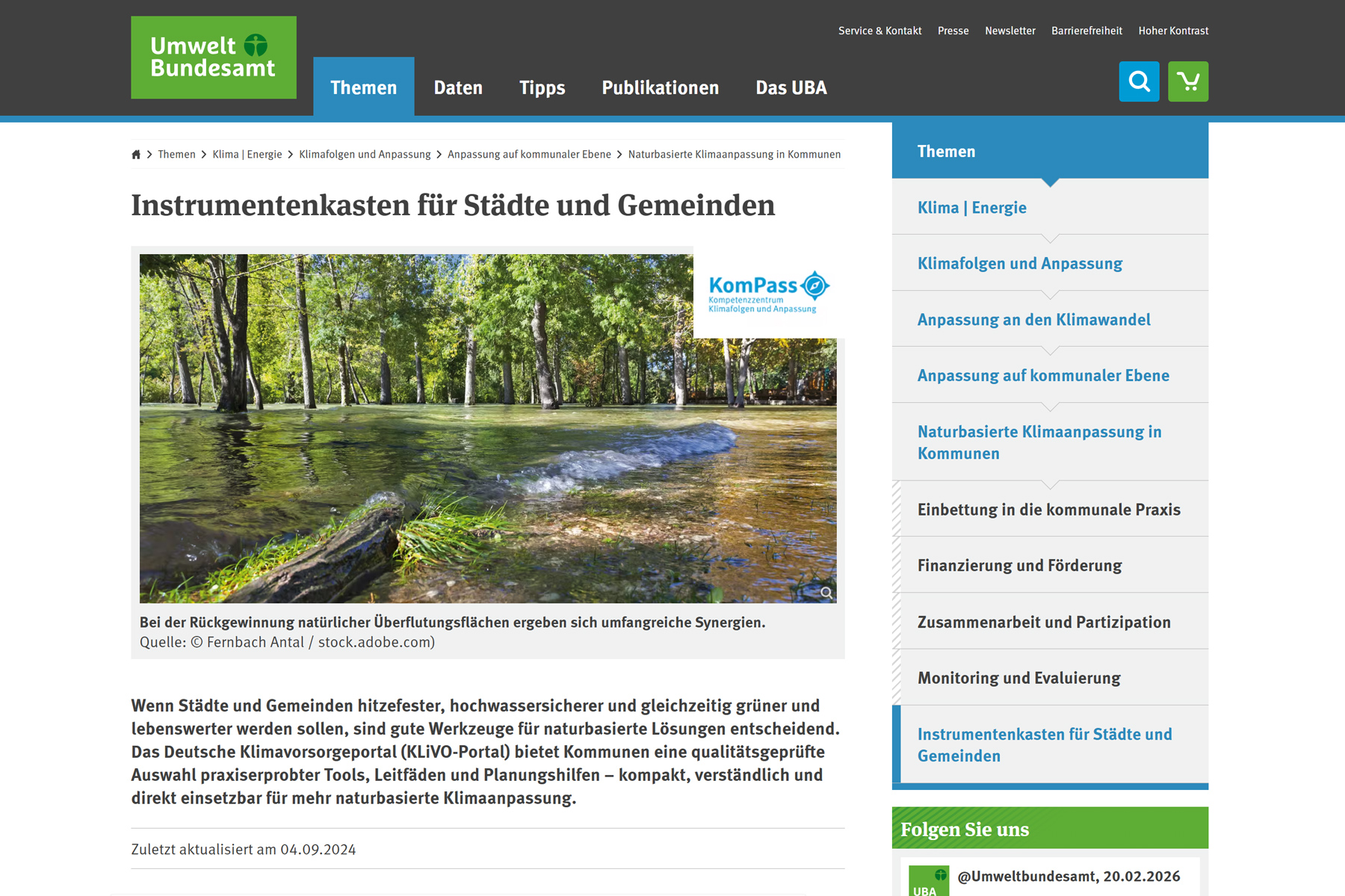
German Environment Agency (ed.): Naturbasierte Klimaanpassung in Kommunen. Topic page compiled by Ecologic Institute on behalf of the German Environment Agency, Dessau-Roßlau. URL: https://www.umweltbundesamt.de/themen/klima-energie/klimafolgen-anpassu…
German Environment Agency (ed.) 2019: Renaturierung von Fließgewässern. Internetportal compiled by Kemper M., Lamberty G., Wagner F. and Zumbroich T. on behalf of the German Environment Agency, Dessau-Roßlau. URL: www.uba.de/renaturierung
Umweltbundesamt 2019: Naturnaher Hochwasserschutz an der Fulda. Video. Online: https://youtu.be/8-A4Oh0pqaY
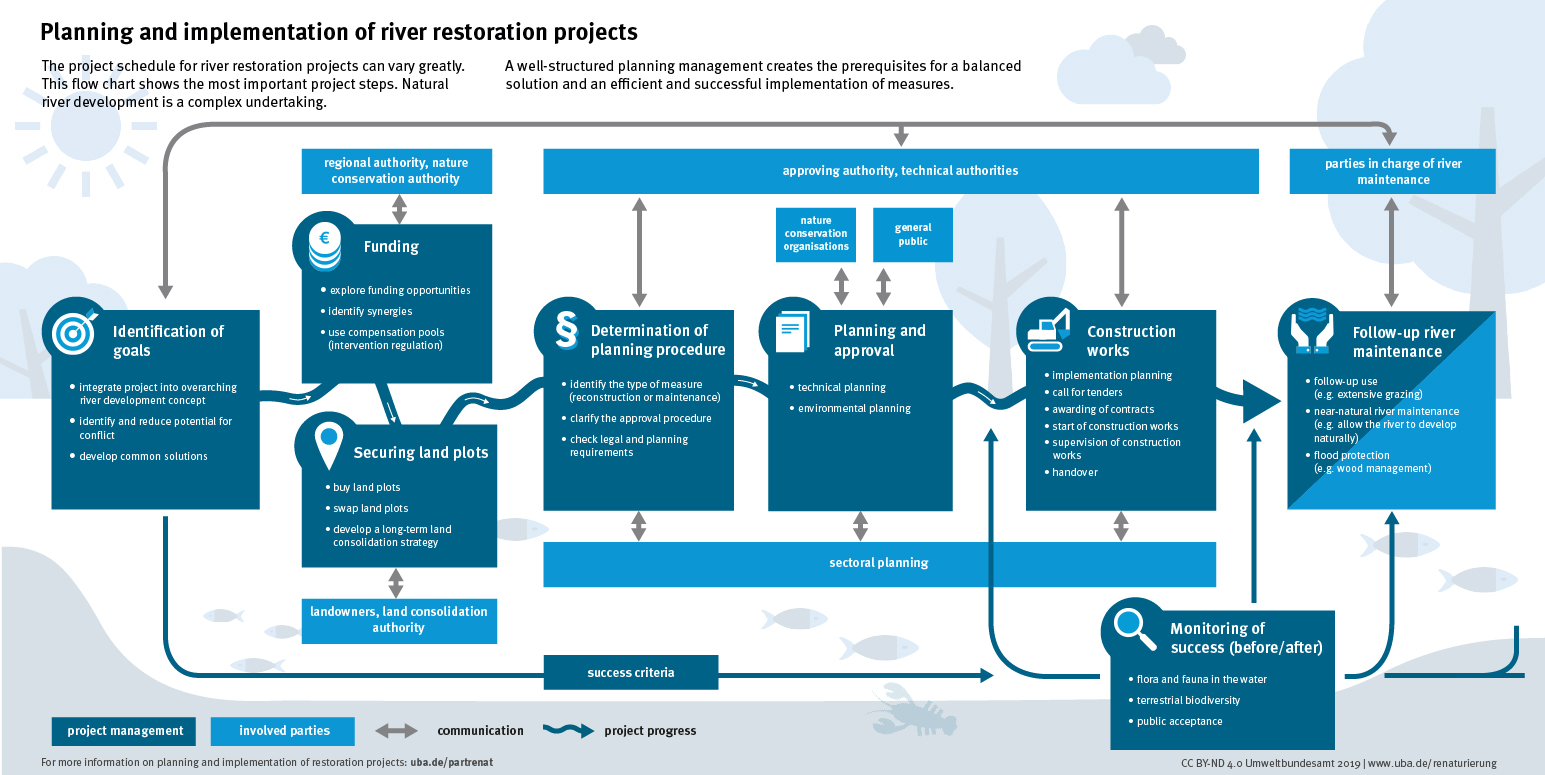
Umweltbundesamt (2019): Planning and implementation of restoration projects. Infographic. Online: uba.de/planrenat