Inklusive Öffentlichkeitsarbeit für naturbasierte Klimaanpassung
Wege zur Teilhabe vulnerabler und schwer erreichbarer Gruppen
- Publication
- Citation
Felthöfer, Charlotte; Tröltzsch, Jenny; Bueb, Benedict; Mederake, Linda (2026): Inklusive Öffentlichkeitsarbeit für naturbasierte Klimaanpassung. Wege zur Teilhabe vulnerabler und schwer erreichbarer Gruppen. Herausgegeben vom Umweltbundesamt, Fachgebiet I 2.8, Aktionsprogramm Natürlicher Klimaschutz. Dessau-Roßlau. ISSN 2363-832X.
This guide, which was compiled by Ecologic Institute on behalf of the German Environment Agency, offers local authorities practical guidance on how to make public relations work on nature-based climate adaptation inclusive. The aim is to inspire new target groups to learn about nature-based solutions and climate adaptation – and to actively involve them in related activities.
Inclusive communications as an opportunity for citizens and municipalities
Nature-based climate adaptation can only be effective if it reaches people. Many local authorities are already involved in education and public awareness campaigns on climate adaptation and green-blue infrastructure. However, traditional communication and participation formats often only reach a limited section of the population, while other groups are hardly addressed at all. The challenge lies in reaching those groups that have hardly been reached so far – for example, the elderly, young people, people with low incomes or low levels of education, and migrant communities. It is also often these groups that are disproportionately affected by the consequences of climate change.
The guide shows how local authorities can identify barriers, take different realities of life into account and adapt their communication accordingly. The aim is to enable participation, build trust and strengthen long-term acceptance of adaptation measures.
Tailoring messages to diverse target groups
One focus is on target group-oriented communication. The guide shows how people from different backgrounds, with different life realities and communication needs, can be better reached. Starting with approaches to categorising target groups, the guide explains how public relations work can better reach these different target groups, for example, through accessible language, culturally sensitive imagery or cooperation with local multipliers. This makes communication more tangible and relevant for groups that are often underrepresented in formal participation processes.
Participation where people are
The guide focuses on low-threshold formats that are suitable for either providing specific target groups with information on nature-based climate adaptation or involving them in the planning and implementation of corresponding measures. Instead of tying participation to formal events, communication and participation opportunities are shifted to people's everyday lives, for example in neighbourhoods, schools, community centres or public green spaces.
Learning from practice
The guide presents nine specific measures and examples of good practice, ranging from neighbourhood walks and participatory workshops to creative formats, urban gardening projects and ambassador programmes.
Numerous case studies from German municipalities illustrate how inclusive communication can work in practice. They demonstrate how cooperation with local organisations, social institutions and trusted intermediaries helps reach vulnerable or hard-to-reach groups and integrate their perspectives into planning and implementation.
A practical resource for municipalities
It is aimed at local government employees such as climate adaptation managers and employees of social institutions. It shows how inclusive public relations work can be successful: through new, exciting formats; targeted communication; and strong partnerships that enable the exchange of best practices. It does not provide a rigid step-by-step plan but rather a flexible set of principles, tools and examples that can be adapted to local contexts.
The guide was developed as part of the ‘Climate Adaptation Naturally!’ project and is available free of charge as a PDF file.
Contact

- Language
-
German
- Authorship
- Credits
Editing: Dr. Andreas Huck (UBA)
Typesetting and layout: Lena Aebli (Ecologic Institute)- Funding
-
German Environment Agency (UBA), Germany - Published by
-
German Environment Agency (UBA), Germany - Year
- Dimension
- 60 pp.
- ISSN
-
2363-832X
- Project
- Project ID
- Table of contents
-
Click to show full table of contents
- Keywords
-
nature-based solutions planning, climate adaptation tools, urban climate resilience, spatial planning for adaptation, ecosystem-based adaptation measures, municipal climate strategies, climate adaptation implementation, decision-support tools for municipalities, urban resilience planning, climate adaptation guidanceGermany, German municipalities, local authorities, urban areas, cities and towns, municipal level, European context, regional planning, local climate governance, urban regionsinclusive communication, target group analysis, audience segmentation, barrier analysis, stakeholder mapping, participatory communication, low-threshold engagement, outreach methods, co-creation, community-based approaches, social milieu analysis, Sinus Milieus, motivation-based segmentation, plain language, easy-to-read language, multilingual communication, culturally sensitive communication, visual communication, narrative approaches, framing, participatory formats, neighbourhood walks, workshops, co-design processes, ambassador programmes, cooperation with local organisations, trust-based intermediaries, case study analysis
Stüdeli, Lena; Bueb, Benedict (2026): Wirkungsvolle Pressearbeit für naturbasierte Klimaanpassung. Ein Kurzleitfaden für Kommunen. Herausgegeben vom Umweltbundesamt, Fachgebiet I 2.8 – Vorsorgende Umsetzungsstrategien und Instrumente der Klimawandelanpassung, Aktionsprogramm Natürlicher Klimaschutz. Dessau-Roßlau. ISSN 2363-832X.
Mederake, Linda; Bueb, Benedict; Felthöfer, Charlotte (2026): Naturbasierte Klimaanpassung mit Stadtkarten. Ein Leitfaden für Kommunen. Herausgegeben vom Umweltbundesamt, Fachgebiet I 2.8 – Vorsorgende Umsetzungsstrategien und Instrumente der Klimawandelanpassung, Aktionsprogramm Natürlicher Klimaschutz. Dessau-Roßlau. ISSN 2363-832X.
Tröltzsch, J., Bueb, B., Davis, M., Dengler, F., Dicke, F., Knoblauch, D., Kupilas, B., Mederake, L., Naumann, S., Pumberger, M., Scholl, L., De la Vega, R., & Georgi, B. (2025). Naturbasierte Lösungen für die kommunale Klimaanpassung stärken: Herausforderungen und Lösungsansätze. Umweltbundesamt. https://doi.org/10.60810/openumwelt-7902
Dicke, F., Tröltzsch, J., Bueb, B. (2025). Jenseits öffentlicher Gelder: Wie Kommunen naturbasierte Lösungen für die Klimaanpassung finanzieren können. Fact Sheet. Umweltbundesamt: Dessau-Roßlau.
Bundesamt für Naturschutz (Hrsg.) (2024): Städte grün und vielfältig (um)gestalten. Praxisleitfaden für Kommunen zur Berücksichtigung von biologischer Vielfalt in Gebieten der Städtebauförderung. Bonn.
Bundesamt für Naturschutz (ed.) (2025): Stadtnatur-Pläne als Strategie für deutsche Kommunen. Empfehlungen zu "Urban Nature Plans" aus der EU-Biodiversitätsstrategie 2030. Bonn.
German Environment Agency (ed.): Naturbasierte Klimaanpassung in Kommunen. Topic page compiled by Ecologic Institute on behalf of the German Environment Agency, Dessau-Roßlau. URL: https://www.umweltbundesamt.de/themen/klima-energie/klimafolgen-anpassu…
German Environment Agency (ed.) 2019: Renaturierung von Fließgewässern. Internetportal compiled by Kemper M., Lamberty G., Wagner F. and Zumbroich T. on behalf of the German Environment Agency, Dessau-Roßlau. URL: www.uba.de/renaturierung
Umweltbundesamt 2019: Naturnaher Hochwasserschutz an der Fulda. Video. Online: https://youtu.be/8-A4Oh0pqaY
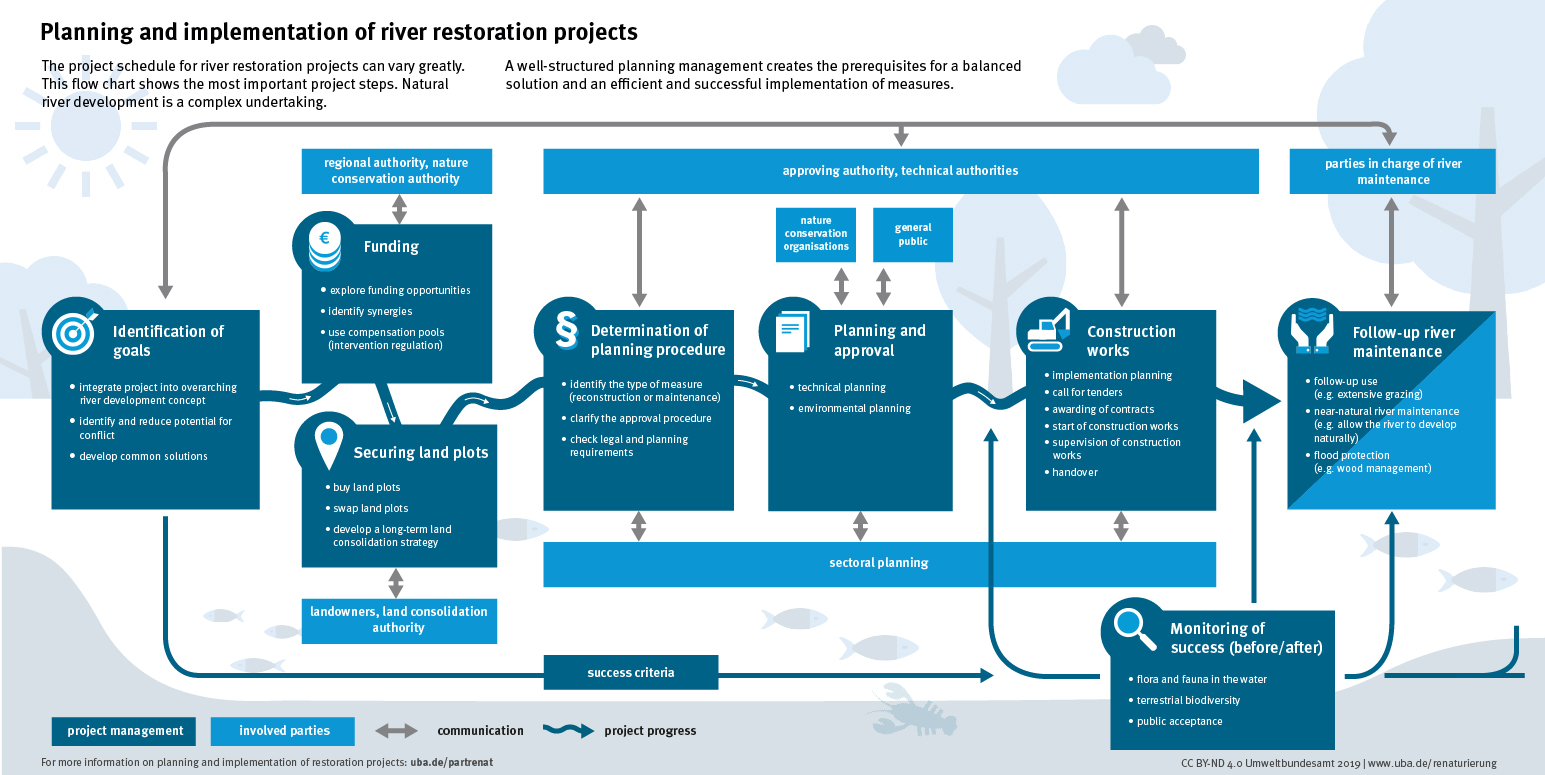
Umweltbundesamt (2019): Planning and implementation of restoration projects. Infographic. Online: uba.de/planrenat