This guide shows how municipalities can systematically identify, assess and compare the costs and NbS. It takes users through a stepwise process on how to go about assessing costs and benefits. Documentation tables and guiding questions help apply each step to a specific project.
More green spaces and trees can help nature thrive in cities. But how much they actually contribute to biodiversity depends on their ecological quality, how well they are connected and how they are managed over the long term. This discussion paper identifies the conditions cities need to develop and maintain high-quality urban nature.
The brief links these findings to concrete recommendations for implementing Regulation (EC) No 1107/2009 more effectively. These include updating EFSA guidance and the data requirements under Regulations (EU) No 283/2013 and 284/2013, expanding the use of sensitive species and endpoints, improving assessments of pesticide mixtures and environmental fate, and better integrating non-dietary exposure and vulnerable life stages into regulatory testing. Many of these improvements could therefore be introduced within the existing EU approval framework.
Published as a Comment in Nature Reviews Biodiversity in 2026, the article "Implementation of the EU Nature Restoration Regulation requires a shift from restoration targets to restoration landscapes" explores the next phase of implementing the EU Nature Restoration Regulation. Daniel Hering, Benjamin Kupilas and Rafaela Schinegger argue that achieving the Regulation's ambitious objectives now requires a shift from setting restoration targets to developing spatially coordinated restoration landscapes, supported by effective governance, strategic spatial planning, sustainable financing and strong stakeholder engagement.
The European Commission’s proposed Omnibus Simplification Package aims to streamline the authorisation of pesticides and reduce regulatory burdens within the European Union. However, a new Policy Forum article published in Science argues that the proposal could significantly weaken environmental risk assessment procedures and increase risks to biodiversity and human health. According to the authors, the current EU pesticide framework already contains important gaps, including insufficient consideration of impacts on many non-target organisms, cumulative effects of multiple pesticides, and sublethal ecological impacts. Rather than addressing these shortcomings, the Omnibus proposal may exacerbate them.
How can Europe finance large-scale ecosystem restoration at a time of growing pressure on public budgets?
A new Biodiversa+ policy brief explores how well-designed Public-Private Partnerships (PPPs) can help mobilise private investment while safeguarding ecological integrity and delivering long-term societal benefits. Building on the EU Nature Restoration Regulation, the brief outlines practical recommendations to create investment-ready restoration projects, strengthen public-private collaboration, and establish the policy conditions needed to scale up private financing for nature restoration across Europe.
Nature-based solutions (NbS) at the landscape scale are increasingly recognised for their role in supporting biodiversity, enhancing ecological connectivity and contributing to climate change adaptation. However, their assessment and implementation remain complex. This article examines these challenges using the concept of pondscapes – networks of ponds and their surrounding terrestrial habitats – as a case for landscape-scale NbS.
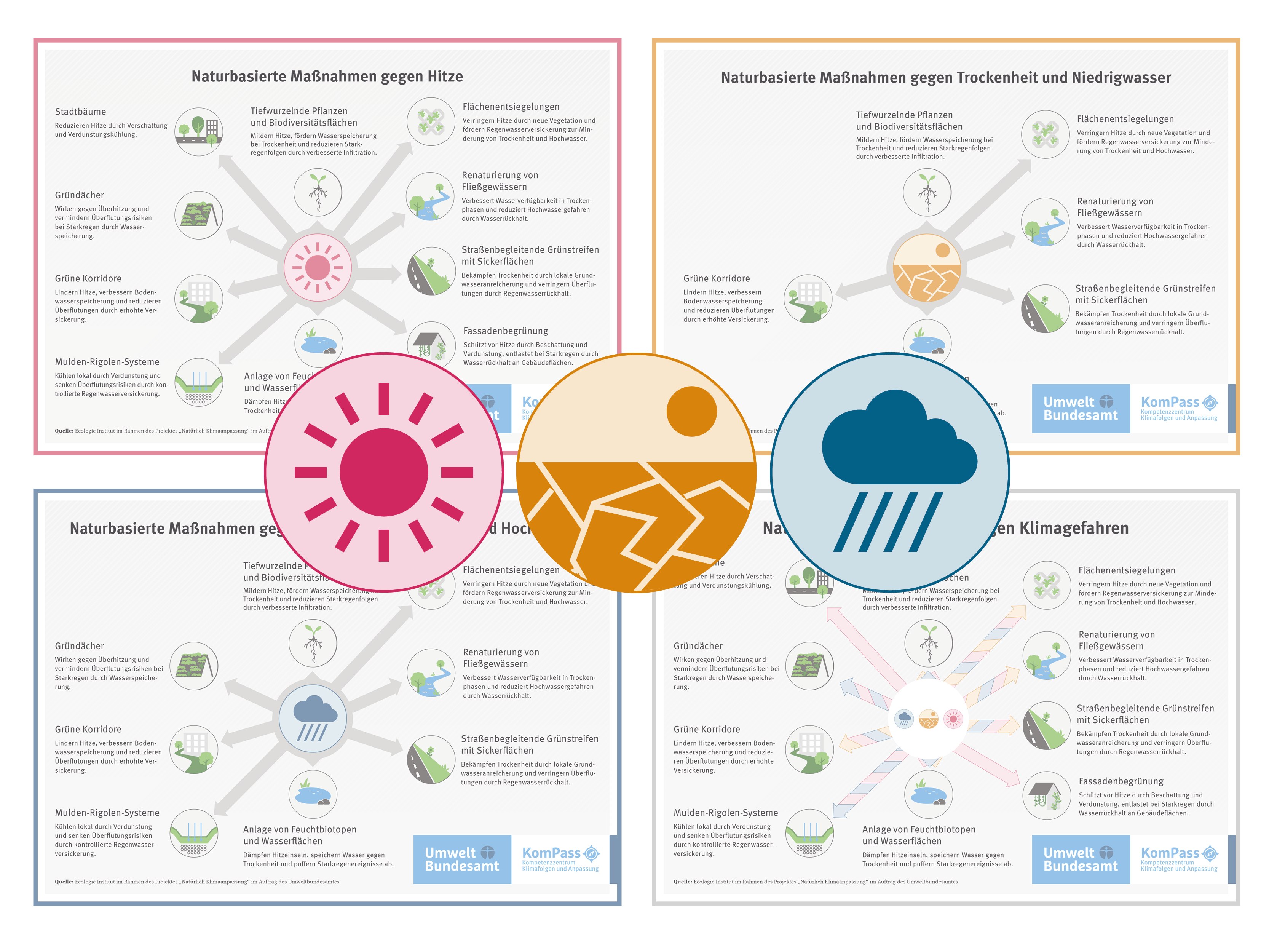
Climate change is affecting cities in various ways: heatwaves are becoming more frequent, flooding is occurring more often, and prolonged periods of drought are putting pressure on water resources. This series of infographics provides an overview of key climate-related risks and shows how nature-based solutions can help mitigate them.
What do shaded paths, green roofs and restored waterways have in common? In many cities, they are already part of the urban landscape – yet often remain unnoticed. This guide, published by the German Environment Agency, focuses on these existing measures. It explains how municipalities can use city maps to make nature-based climate adaptation visible, place it in context and communicate it in a transparent and accessible way.
Nature-based climate adaptation unfolds not only in urban space but also in public perception. Measures such as urban greening, water retention or heat action plans require clear and targeted communication in order to be understood, accepted and supported. A new short guide published by the German Environment Agency outlines how municipalities can use press work strategically to communicate nature-based climate adaptation in a clear and structured way.
Nature-based climate adaptation can only be effective if it reaches the people it is meant to serve. Inclusive public communication plays a key role in this process: it helps ensure that nature-based solutions are not only planned and implemented but also understood, accepted and shaped by a wide range of communities. This guide, published by the German Environment Agency, provides practical guidance on how municipalities can design inclusive communication strategies for nature-based climate adaptation.
This publication provides a quantitative overview of the development and status of environmental crime in Germany between 2013 and 2024, based on data from the police crime statistics ("Polizeiliche Kriminalstatistik") and the Federal Statistical Office's criminal prosecution statistics ("Strafverfolgungsstatistik"). The report provides both an overview of general trends and an in-depth account of individual environmental offences. The report was prepared by a team from Ecologic Institute on behalf of the German Federal Environment Agency.
The aim of the analysis is to assess stormwater management measures not only in terms of their hydraulic performance and costs but also to systematically capture their additional ecological, social and economic benefits.
This policy brief offers recommendations for EU and national policymakers to enable diversified funding for nature restoration. It draws on lessons from four Horizon 2020 projects – MERLIN, REST‑COAST, SUPERB, and WaterLANDS – that together worked across Europe to test how restoration projects can attract broader support and financing.
This report presents a strategic, evidence-based approach to support the upscaling of freshwater restoration and implementation of Nature-based Solutions across Europe. Central to the approach is the MERLIN Upscaling Workflow, a flexible decision-support tool that uses Europe-wide datasets to identify high-impact restoration areas.
This pilot roadmap is designed to support national authorities and stakeholders in Romania in develo ping a strategic framework for planning coastal wetland restoration, for example in the context of National Restora tion Plans. It draws on the latest scientific data, tools and methods developed by the EU-funded project RESTORE4Cs.
This pilot roadmap is designed to support national authorities and stakeholders in Portugal in developing a strategic framework for planning coastal wetland restoration, for example in the context of National Restoration Plans.
"RESTORE4Cs Restoring Coastal Wetlands in Europe – Implementation Roadmap to Guide National Action" is a practical guidance document, designed to support national authorities and stakeholders in developing or strengthening strategies for coastal wetland restoration, helping countries meet these and other related obligations. The Implementation Roadmap builds on the latest scientific knowledge and integrates key RESTORE4Cs findings, tools and methodologies into a coherent decision-support framework.
Implementing the EU Nature Restoration Regulation (NRR) requires reliable spatial information on habitats, land use and ecosystem pressures. This RESTORE4Cs policy brief highlights an important challenge: established classification systems describe landscapes differently, which can influence environmental assessments.
Myanmar is a global biodiversity hotspot, home to over 570 freshwater fish species and many endemics. Yet its rivers face mounting pressure from pollution, land-use change and declining water quality. This study co-authored by Ecologic Institute's Dr. Benjamin Kupilas offers novel insights into how tropical fish communities respond to these stresses.
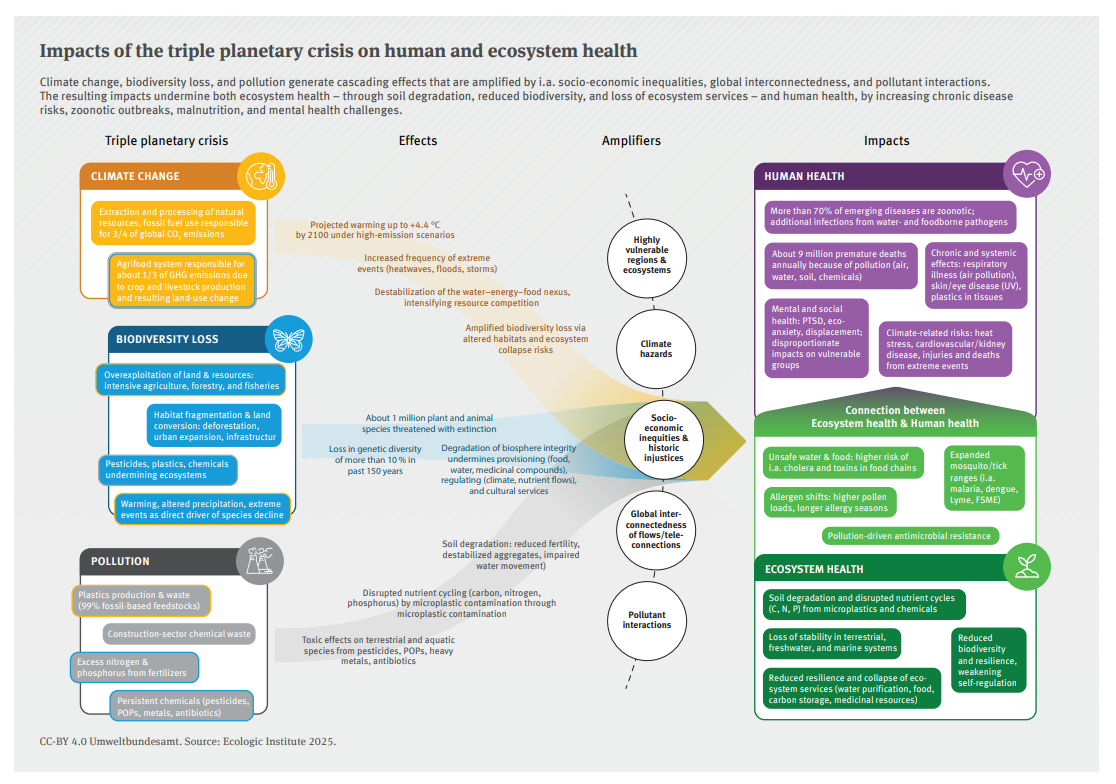
The triple planetary crisis is a systemic challenge, not three separate issues: climate change, biodiversity loss, and pollution reinforce one another through shared drivers and feedback, threatening planetary and human well-being. It is driven by fossil fuel dependence, unsustainable production and consumption, overexploitation of land and resources, and structural inequalities. The analysis concludes that the triple crisis can only be effectively addressed through systemic, cross-sectoral, and justice-oriented approaches. By linking resource governance, NbS, and transformative change, this report highlights how today’s triple crisis can be turned into an opportunity to regenerate ecosystems, reduce inequalities, and build resilient societies within planetary boundaries.
This fact sheet summarizes the information contained in the publication Burgos Cuevas et al. (2025): Moving from interconnected crises to systemic solutions. Resource efficiency, nature-based solutions, and systemic transformation as responses to the complexity of the triple planetary crisis. Interim report, Climate Change 83/2025. German Environment Agency: Dessau-Roßlau. https://doi.org/10.60810/openumwelt-8108.
Humanity has already exceeded six of the nine planetary boundaries, with climate change, biodiversity loss, and pollution pushing the Earth system beyond its safe operating space. Because these boundaries interact through complex feedback loops, surpassing one accelerates pressures on the others, creating cascading effects that amplify environmental degradation. This interconnected dynamic is driving a systemic triple planetary crisis, or polycrisis, that undermines ecological resilience and threatens long-term human well-being. Addressing it requires integrated, cross-sectoral approaches that tackle shared drivers and deliver co-benefits across environmental and socio-economic domains.
This solution-oriented infographic showcases nature-based solutions (NbS) as systemic responses to the triple planetary crisis, illustrating how measures such as wetland restoration, mangrove protection or urban green infrastructure can simultaneously address climate change, biodiversity loss and pollution, while delivering co-benefits for health, resilience and livelihoods.
Nature-based solutions are central to climate change adaptation. Urban green spaces and waterbodies can reduce heat in cities, for example. How can local authorities implement such measures despite limited resources? This paper presents financing options based on practical examples – from crowdfunding to green bonds – and assesses which ones are suitable and when. It also provides recommendations on how the federal and state governments can provide support.
This guest article by Christoph Heinrich, published in the Table.Forum Biodiversity (Table.Media), outlines the central importance of biological diversity for the functioning of ecosystems and for human livelihoods.
Mediterranean countries share commitments to protect and restore coastal wetlands, but progress is monitored through a range of regional, European and international frameworks. A common evidence base could make these efforts more coherent. A RESTORE4Cs policy brief proposes a harmonised set of indicators to help countries track progress while aligning reporting under the Barcelona Convention with wider biodiversity and climate commitments.
Protecting and restoring coastal wetlands is embedded in several European environmental and climate policies. But assessing whether these efforts are succeeding requires comparable information on how wetlands are changing over time. A RESTORE4Cs policy brief proposes a common set of indicators to make progress measurable across Europe.
This paper analyses the European Union's (EU) policy framework, alongside international and regional agreements relevant to wetland conservation and restoration, focusing on coastal ecosystems. Drawing on policy content analysis, it assesses how 36 EU policies and multilateral agreements support or limit coastal wetland restoration and conservation efforts in Europe.
This report summarizes the outcomes of the online workshop held on 4 September 2025. The workshop was organized by the German Federal Agency for Nature Conservation (BfN) on behalf of the Alpine Biodiversity Board (ABB) of the Alpine Convention and implemented and moderated by the Ecologic Institute. The discussion focused on how cross-border cooperation can strengthen the implementation of the EU Nature Restoration Regulation (NRR) in the Alpine region.
Aquatic insects that emerge from streams are a crucial energy subsidy for riparian predators such as spiders. When streams are disturbed by human activities, these impacts can cross ecosystem boundaries, disrupting aquatic–terrestrial food web connectivity. This study, co-authored by Dr. Benjamin Kupilas from Ecologic Institute together with international partners, explores how such connections function and how they are shaped by human disturbance.
Der Policy Brief zeigt, wie sich pelagische Fischereien im Nordostatlantik trotz Klimawandel, veränderter Fischwanderungen und internationaler Nutzungskonflikte nachhaltiger bewirtschaften lassen. Er verbindet wissenschaftliche Erkenntnisse mit den Perspektiven von Stakeholdern und formuliert konkrete Empfehlungen für ein resilientes, grenzüberschreitendes Fischereimanagement.
This report published under the EU-funded GoNaturePositive! project offers a comprehensive baseline assessment to support the transition toward a nature-positive economy. The report provides an in-depth analysis of EU policy instruments and co-operative initiatives, identifying their alignment with nature positive principles and opportunities to reduce environmental harm, restore ecosystems, and foster systemic change.
This sectoral brief explores how transitioning to a Nature-Positive Economy requires transforming marine industries from drivers of biodiversity loss to forces for ocean restoration. It was developed under the EU research project GoNaturePositive!
This brief explores how transitioning to a Nature-Positive Economy requires transforming tourism from a driver of environmental degradation into a force for ecosystem restoration. It was developed under the EU research project GoNaturePositive!