© Ecologic Institute, 2026
Transatlantic Exchange on Nature-based Solutions in Urban and Rural Contexts
Mainstreaming Nature-based Solutions
- Presentation
- Date
-
- Location
- Berlin, Germany
- Speech
On 15 June 2026, experts from Germany and the United States gathered in Berlin for the workshop "Nature-based Solutions in urban and rural contexts in the United States and Germany", jointly organised by UfU – Independent Institute for Environmental Issues and the German-American Nature-Based Solutions Exchange (GANBASE). Held at the Haus der Demokratie in Berlin, the event brought together practitioners, researchers, public authorities and civil society actors to exchange experiences on how nature-based solutions can be advanced across different governance, ecological and socio-economic contexts. Ecologic Institute was represented by McKenna Davis, Senior Fellow and Coordinator Nature-based Solutions, who contributed a presentation on "Mainstreaming Nature-Based Solutions in Urban Governance and Planning". The event was also joined by Ecologic Institute alumni Sandra Naumann, now Chief Biodiversity Officer for the City of Berlin, and Prof. Dr. Ulf Stein.
The workshop took place in the context of GANBASE, a transatlantic exchange programme led by former Ecologic Institute colleague Max Gruenig. GANBASE fosters dialogue between German and US stakeholders working on nature conservation, environmental protection and nature-based solutions. The programme provides a platform to share research, lighthouse projects and practical experience and to explore how NbS can be embedded in local, regional and national policy frameworks on both sides of the Atlantic.
Making nature-based solutions standard practice
The workshop addressed nature-based solutions as instruments for climate adaptation and mitigation, biodiversity protection, and socio-economic development. Across three thematic sessions, speakers examined how NbS can help cities and regions respond to heat, flooding, biodiversity decline, infrastructure pressures and social vulnerability.
The first session focused on resilience and climate adaptation, asking where NbS can protect infrastructure and human lives and where grey infrastructure remains necessary. Contributions included examples from Berlin’s sponge city agenda, stream daylighting in New York City, urban environmental acupuncture, and urban rewilding as a multifunctional approach for resilient and inclusive cities.
The second session turned to biodiversity protection and climate mitigation, with a particular focus on how synergies can be strengthened and trade-offs managed. The third session focused on nature-based solutions as socio-economic drivers and receivers, addressing how NbS can deliver social and economic benefits while facing budget constraints, implementation barriers and public acceptance challenges.
Across the discussions, participants stressed the need to treat NbS not only as ecological interventions but also as governance and justice processes. High-quality NbS require attention to who benefits, who participates, who bears costs and who may be excluded from decision-making. This is particularly relevant where NbS intersect with land use, housing, infrastructure investment, public space, cultural identity and local livelihoods.
Governing implementation across policy and practice
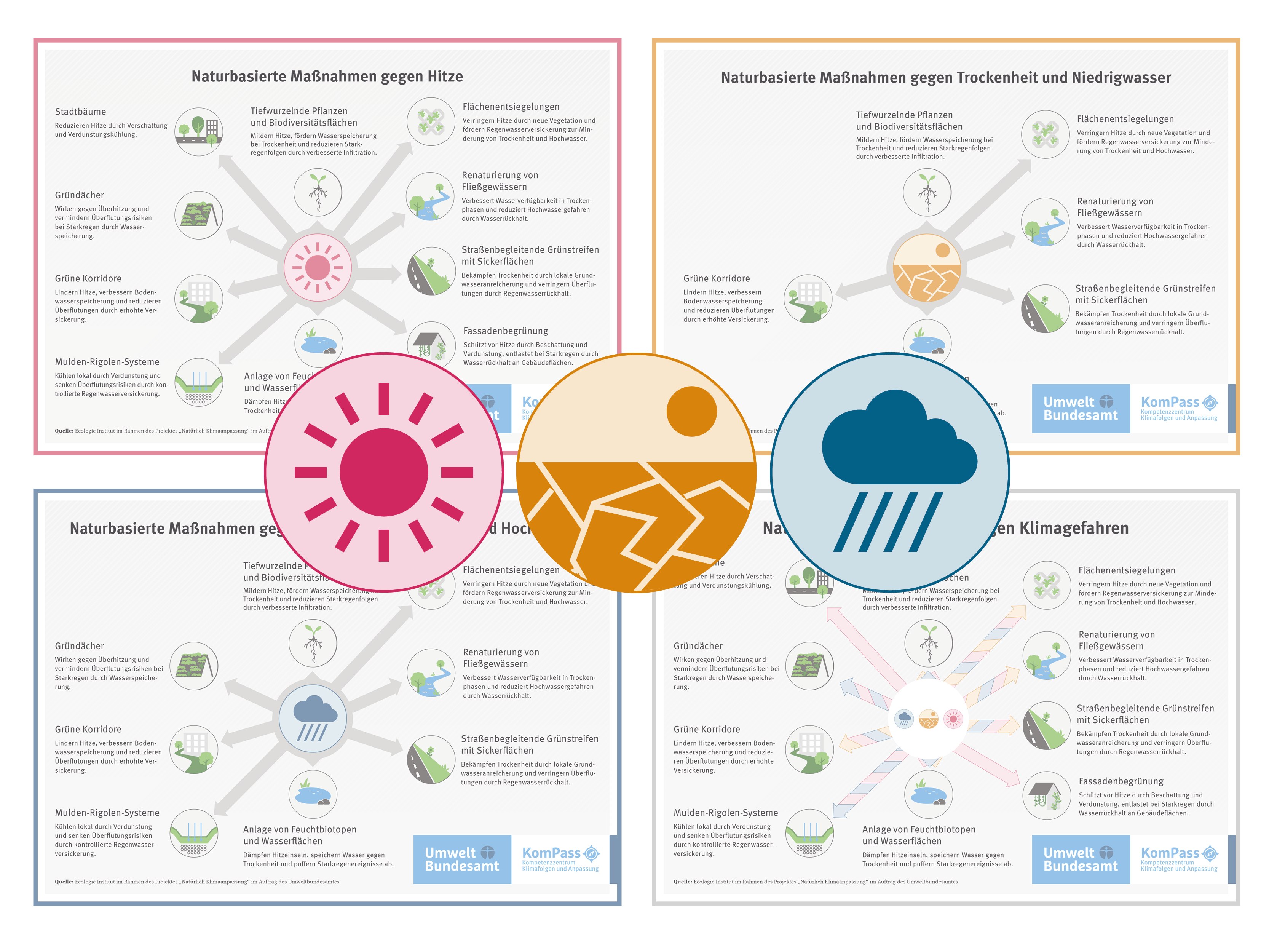
McKenna Davis presented findings from the Urban Governance Atlas, the "Natürlich Klimaanpassung!" project, and her report for the European Commission on co-creating inclusive NbS. Her presentation underlined that nature-based solutions are no longer a niche concept and are supported by a growing body of evidence on their effectiveness. However, embedding them in everyday planning and implementation remains a governance challenge for municipalities.
Drawing on more than 250 policy instruments from 41 countries included in the Urban Governance Atlas, McKenna Davis highlighted four recurring governance levers for advancing NbS: coordination, participation, learning and institutionalisation. German examples from the Atlas illustrated how municipalities and regions are using strategic frameworks, participatory processes, monitoring systems, regulatory tools and financial incentives to support NbS implementation.
A core message of the presentation was that there is no universal governance model for NbS. Effective implementation depends on locally appropriate policy mixes, adequate municipal capacity, cross-departmental cooperation and long-term financing.
Contact

- Event
-
Nature-based Solutions in urban and rural contexts in the United States and Ger…
- Organizer
-
Independent Institute for Environmental Issues (UfU), Germany - Speech
- Date
-
- Location
- Berlin, Germany
- Language
-
English
- Project
- Project ID
- Keywords
-
nature-based solutions governance, urban resilience, sustainable urban planning, ecosystem-based adaptation, climate-resilient cities, urban biodiversity, resilient infrastructure, sustainable land-use planning, nature-positive cities, urban ecosystem services, climate adaptation planning, environmental governance, participatory urban planning, integrated urban development, urban sustainability, ecosystem restoration, climate resilience governance, sustainable city development, policy integration for nature-based solutionsGermany, United States, Europe, North Americatransatlantic cooperation, German-American exchange, cross-border environmental cooperation, transatlantic policy dialogue, transatlantic knowledge exchange, policy instrument mapping, comparative policy analysis, co-creation approaches, participatory planning, monitoring systems, strategic policy frameworks, regulatory instruments, financial incentive mechanisms, cross-sector collaboration, governance levers analysis, evidence-based policymaking, knowledge sharing, policy mainstreaming, institutional analysis, multi-stakeholder exchange
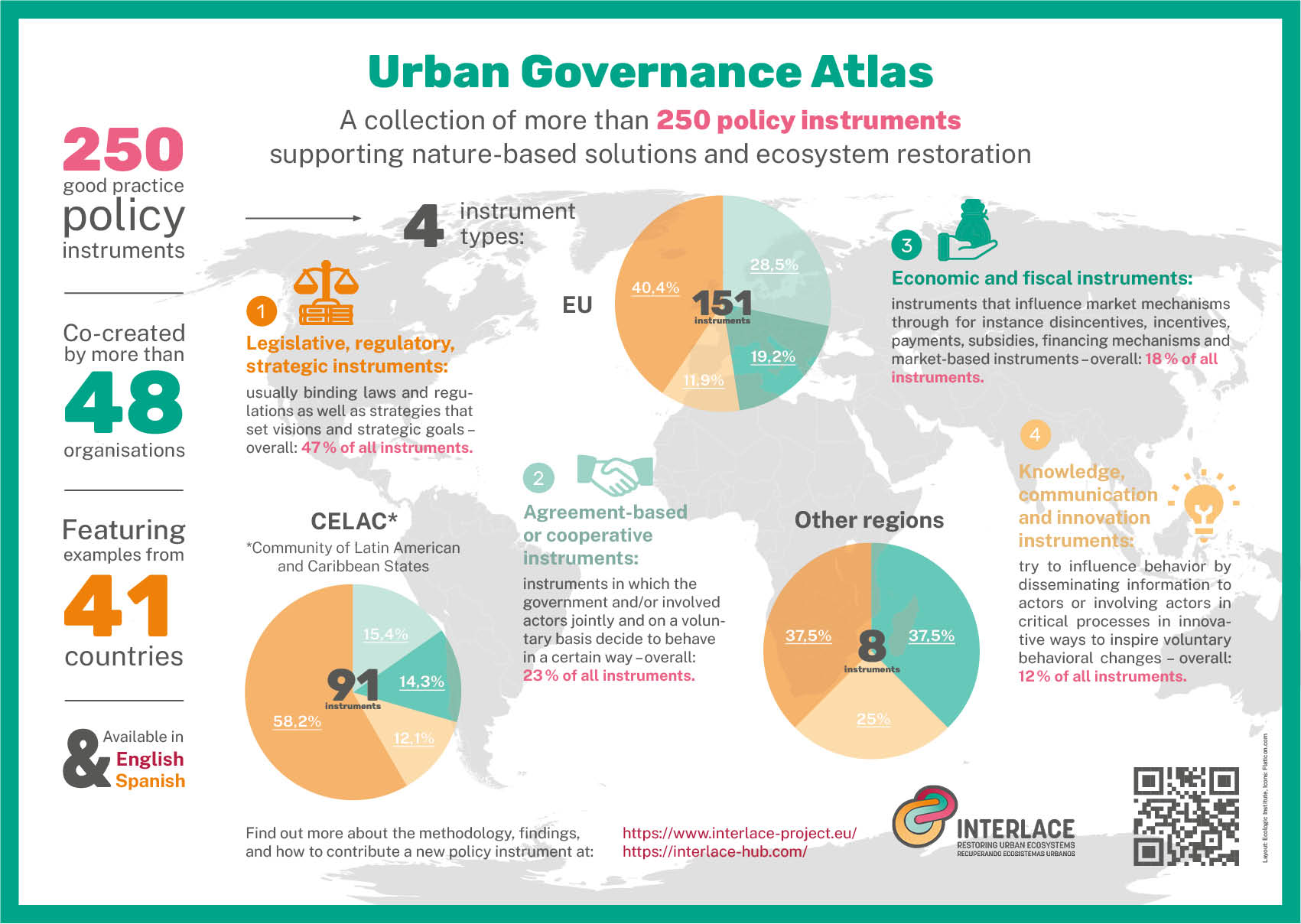
INTERLACE project consortium 2023: Urban Governance Atlas. Interactive database. Published on 11 May 2023. Online: https://interlace-hub.com/urban-governance-atlas.
European Commission: Directorate-General for Research and Innovation, Co-creating nature-based solutions with commonly excluded stakeholders – Insights from practice and research, Publications Office of the European Union, 2025, https://data.europa.eu/doi/10.2777/4288584
International Networking Workshop on Urban Nature
- Duration
-
-
- Funding
-
Federal Agency for Nature Conservation (BfN), Germany
Developing NbS Scaling Approaches to Achieve Just Transformative Change (Fair Nature)
- Duration
-
-
- Funding
-
European Biodiversity Partnership (Biodiversa+), International
GoNaturePositive!
- Duration
-
-
- Funding
-
European Commission, Directorate-General Research & Innovation (DG Research & Innovation), International