Geopolitical tensions, volatile energy markets and the focus on strategic autonomy have pushed industrial competitiveness to the top of the political agenda. European climate policy therefore requires close coordination between emissions reduction, investment security and competitiveness. In a background paper, Ariadne researchers summarise how governance, financing, industrial transformation, the EU Emissions Trading Scheme and energy infrastructure need to simultaneously ensure decarbonisation, economic resilience and public support.
Europe’s climate movement has adopted different approaches to engaging with far-right parties. In this Tagesspiegel opinion piece, Nils Meyer-Ohlendorf of the Ecologic Institute and Erik Tang of Green Transition Denmark discuss these approaches and draw conclusions. The views expressed are solely those of the authors.
ECNO’s 2026 State of EU Progress to Climate Neutrality report provides a comprehensive assessment of whether the European Union is moving quickly enough to meet its climate goals. Drawing on a broad set of indicators and policy analysis, the report evaluates progress across the economy and identifies where stronger implementation could reduce exposure to fossil fuel dependence, supply-chain vulnerabilities, affordability challenges and climate-related risks.
The paper assesses four policy options for integrating Article 6 credits into the EU ETS through a central intermediary rather than allowing companies to purchase credits directly. It argues that this indirect approach would provide greater oversight of credit quality and supply, helping to preserve the EU ETS's role in driving domestic emissions reductions while offering limited flexibility where appropriate.
This report examines the penalty provisions contained in the revised Draft Emergency Ordinance (DEO) proposed by the Romanian government in April 2026 to implement the EU Methane Emissions Regulation (EUMR).
Researchers at Ecologic Institute have developed a new tool to help governments to produce socially just climate adaptation strategies. The Just2Adapt tool allows the user to analyse the justice dimensions of Heat Action Plans at the strategic level as well as at the level of individual measures. It is important that heat adaptation strategies integrate social justice considerations because of the unequal way in which the heat-health effects of climate change are distributed across the population.
As the European Union considers to reform its Emissions Trading System (EU ETS) by integrating permanent carbon dioxide removals (CDR), this report examines safeguards to support the gradual scale-up of permanent removals whilst keeping their quantity under control to manage risks and ensure incentives for reducing emissions remain
In light of the agreed expansion of European emissions trading (inter alia the gradual inclusion of maritime transport and the introduction of the EU ETS 2), the study contains an analysis of the current sanctions regime in emissions trading. The fundamental amendment to the TEHG brought about by the TEHG EU Alignment Act 2024 has already been taken into account. Proposals for a more effective sanctions regime are put forward, relating both the enforcement of existing regulations and reforms of these regulations. The study focuses on administrative offence law.
ECNO’s 2026 update provides the first comprehensive assessment of all 27 final National Energy and Climate Plans (NECPs). It evaluates whether Member States’ contributions and policy frameworks are sufficient to meet the EU’s 2030 climate and energy targets. The results show a clearer and more complete picture than previous assessments. However, the overall conclusion remains unchanged: despite some progress, the EU is still not fully on track to meet its 2030 targets.
Nature-based solutions (NbS) at the landscape scale are increasingly recognised for their role in supporting biodiversity, enhancing ecological connectivity and contributing to climate change adaptation. However, their assessment and implementation remain complex. This article examines these challenges using the concept of pondscapes – networks of ponds and their surrounding terrestrial habitats – as a case for landscape-scale NbS.
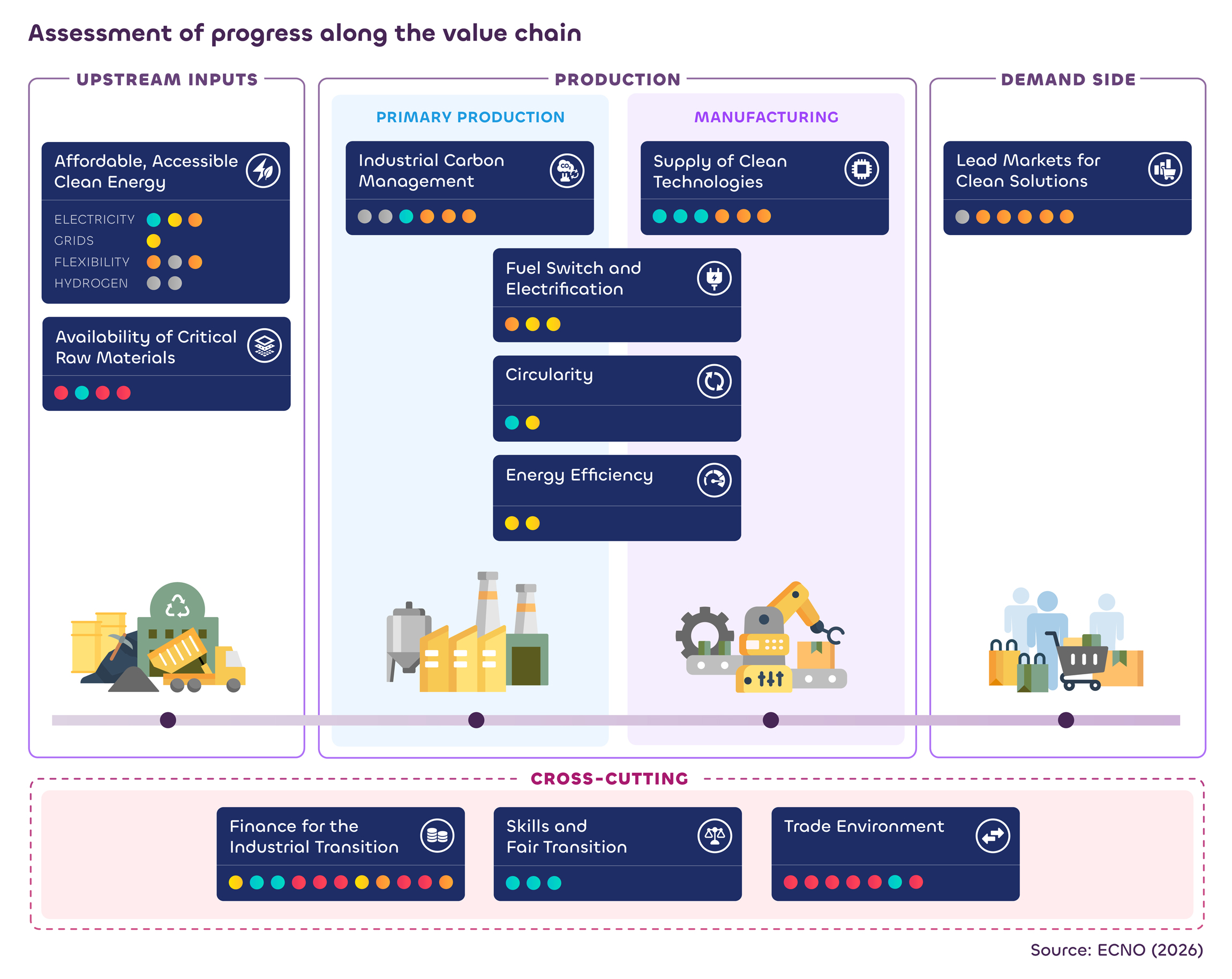
The transition to a clean and competitive industrial base is crucial to strengthening Europe’s resilience and strategic economic independence. The Clean Industrial Transition Monitor by ECNO assesses real-world progress using more than 50 indicators and provides a comprehensive and nuanced picture of both progress and remaining gaps.
The infographic underscores a central insight of the Clean Industrial Transition Monitor: Europe has put in place many of the necessary building blocks for a clean industrial transition. However, achieving scale will depend on addressing remaining bottlenecks and ensuring coherent implementation across all parts of the value chain.
Presented at the European Carbon Farming Summit 2026, this poster highlights key findings on the risks, opportunities and policy implications of integrating temporary carbon units from carbon farming into EU agri-food climate policy.
This policy brief examines how current climate-action rewarding mechanisms address – or fail to address – organic farming as a systemic and climate-resilient approach. It analyses existing monetary, regulatory and supportive instruments at EU level, with a particular focus on the Common Agricultural Policy (CAP) and the Carbon Removal and Carbon Farming (CRCF) Regulation.
This pilot roadmap is designed to support national authorities and stakeholders in Romania in develo ping a strategic framework for planning coastal wetland restoration, for example in the context of National Restora tion Plans. It draws on the latest scientific data, tools and methods developed by the EU-funded project RESTORE4Cs.
The chapter “International climate finance: institutions in the climate regime” by Dr. Ralph Bodle appears in the Research Handbook on Climate Finance and Investment Law. The volume is part of the Research Handbooks in Climate Law series and was published by Edward Elgar Publishing in 2025.
This pilot roadmap is designed to support national authorities and stakeholders in Portugal in developing a strategic framework for planning coastal wetland restoration, for example in the context of National Restoration Plans.
"RESTORE4Cs Restoring Coastal Wetlands in Europe – Implementation Roadmap to Guide National Action" is a practical guidance document, designed to support national authorities and stakeholders in developing or strengthening strategies for coastal wetland restoration, helping countries meet these and other related obligations. The Implementation Roadmap builds on the latest scientific knowledge and integrates key RESTORE4Cs findings, tools and methodologies into a coherent decision-support framework.
Implementing the EU Nature Restoration Regulation (NRR) requires reliable spatial information on habitats, land use and ecosystem pressures. This RESTORE4Cs policy brief highlights an important challenge: established classification systems describe landscapes differently, which can influence environmental assessments.
This paper examines the penalty provisions in the draft Czech implementing law submitted on 11 November 2025 by the Minister for the Environment to the Prime Minister. It briefly considers the draft's legislative status in light of the political situation following the 3–4 October general election, assesses its compliance with the EU-MER, and compares it with good practice in Denmark and with Italy's draft law.
This paper examines the penalty provisions in the draft Romanian implementing law proposed by the Romanian government on 22 July 2025. It briefly considers the draft's legislative status, assesses its compliance with EU-MER, and compares it with good practice in Denmark and with Italy's draft law.
After giving a concise overview of the penalty provisions in the EU Methane Regulation (EU-MER), this paper counters the scaremongering narrative promoted by fossil energy groups that the EU-MER creates "unmanageable liability" for EU fossil-fuel importers through fines of up to 20% of annual turnover.
A competitive, clean, and fair EU economy depends on smarter governance practices. This paper proposes eight priority actions for simpler, leaner, and more performance-oriented transition governance in the EU.
This report, commissioned by the German Federal Agency (UBA), provides a systematic analysis of this triple planetary crisis. It demonstrates why climate change, biodiversity loss, and environmental pollution cannot be understood and tackled in siloes, but instead share common drivers, feedback mechanisms, and cascading effects. The aim of the report is to close knowledge gaps and provide political and scientific actors with an integrated, holistic understanding.
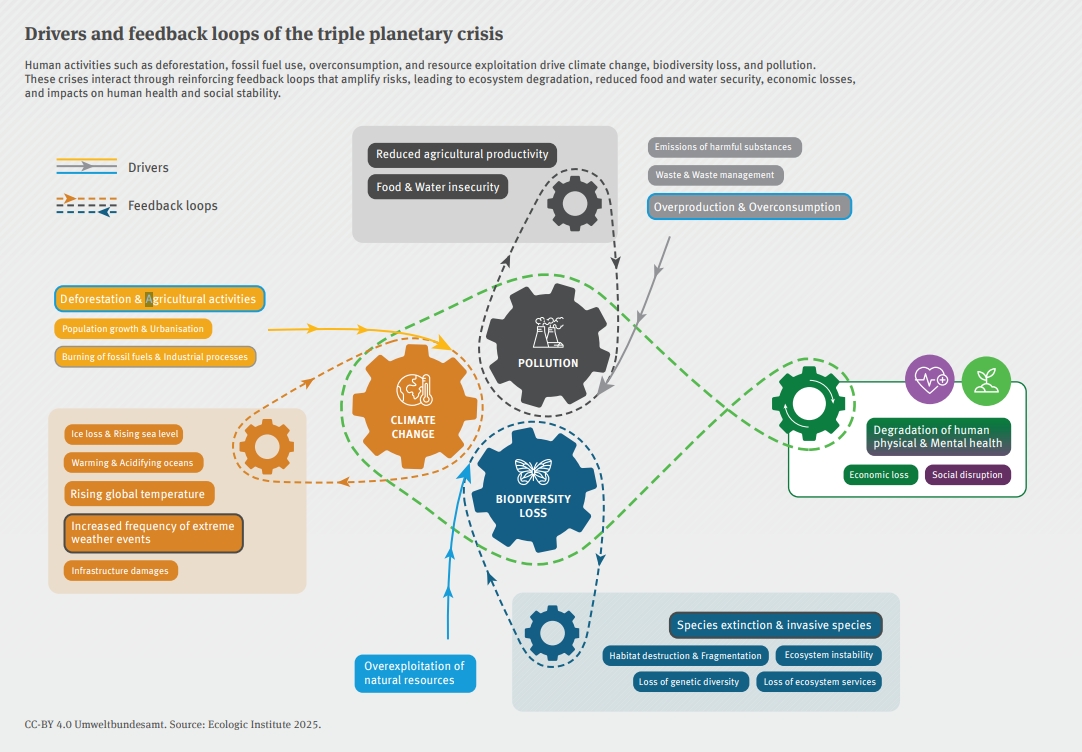
The triple planetary crisis is a systemic challenge, not three separate issues: climate change, biodiversity loss, and pollution reinforce one another through shared drivers and feedback, threatening planetary and human well-being. It is driven by fossil fuel dependence, unsustainable production and consumption, overexploitation of land and resources, and structural inequalities. The analysis concludes that the triple crisis can only be effectively addressed through systemic, cross-sectoral, and justice-oriented approaches. By linking resource governance, NbS, and transformative change, this report highlights how today’s triple crisis can be turned into an opportunity to regenerate ecosystems, reduce inequalities, and build resilient societies within planetary boundaries.
This fact sheet summarizes the information contained in the publication Burgos Cuevas et al. (2025): Moving from interconnected crises to systemic solutions. Resource efficiency, nature-based solutions, and systemic transformation as responses to the complexity of the triple planetary crisis. Interim report, Climate Change 83/2025. German Environment Agency: Dessau-Roßlau. https://doi.org/10.60810/openumwelt-8108.
The fact sheet explains why climate change, biodiversity loss and environmental pollution must be understood as a systemically interconnected crisis driven by shared pressures such as resource use, land-use change and structural inequalities. It highlights how direct and indirect drivers interact across sectors and regions, creating reinforcing feedbacks and compounding risks for ecosystems and societies.
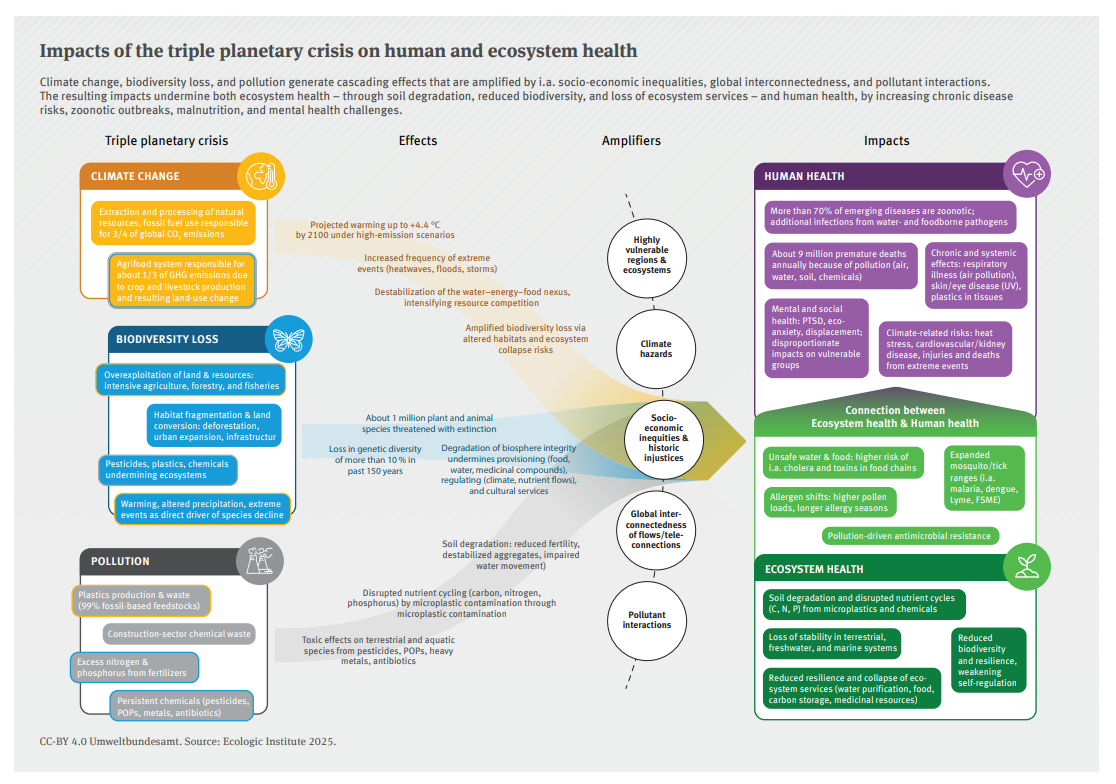
Climate change, biodiversity loss and environmental pollution are deeply interconnected and reinforce one another. This infographic, based on the report "The Interconnected Challenges of Climate Change, Biodiversity Loss and Environmental Pollution: Drivers, Interdependencies and Impacts of the Triple Planetary Crisis", illustrates the main human-driven causes of the triple planetary crisis and the feedback loops that intensify its impacts.
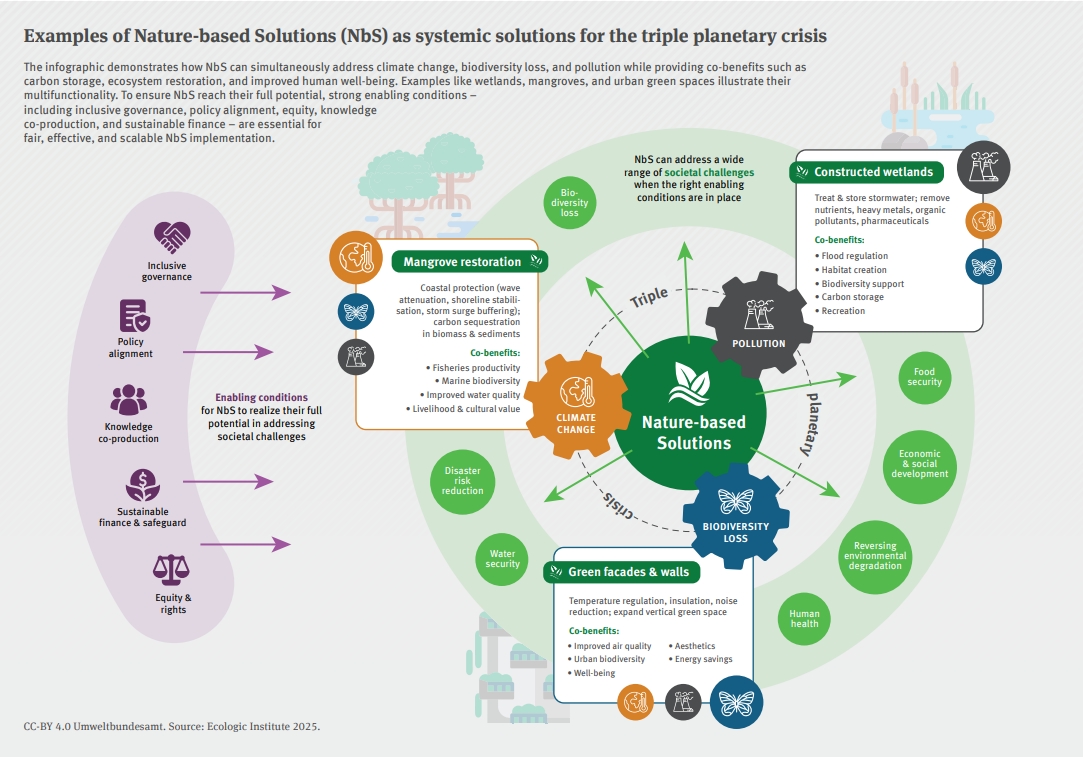
Nature-based solutions (NbS) can address multiple dimensions of the triple planetary crisis at once: climate change, biodiversity loss, and environmental pollution, while delivering benefits for people and ecosystems. This infographic, visualises how NbS can function as systemic responses when designed and implemented under the right conditions. It illustrates how measures such as mangrove restoration, constructed wetlands, and urban green infrastructure can simultaneously contribute to climate mitigation and adaptation, strengthen biodiversity, and reduce pollution-related pressures. It also highlights the broader societal challenges that NbS can support, including water and food security, human health, risk reduction, and reversing environmental degradation.
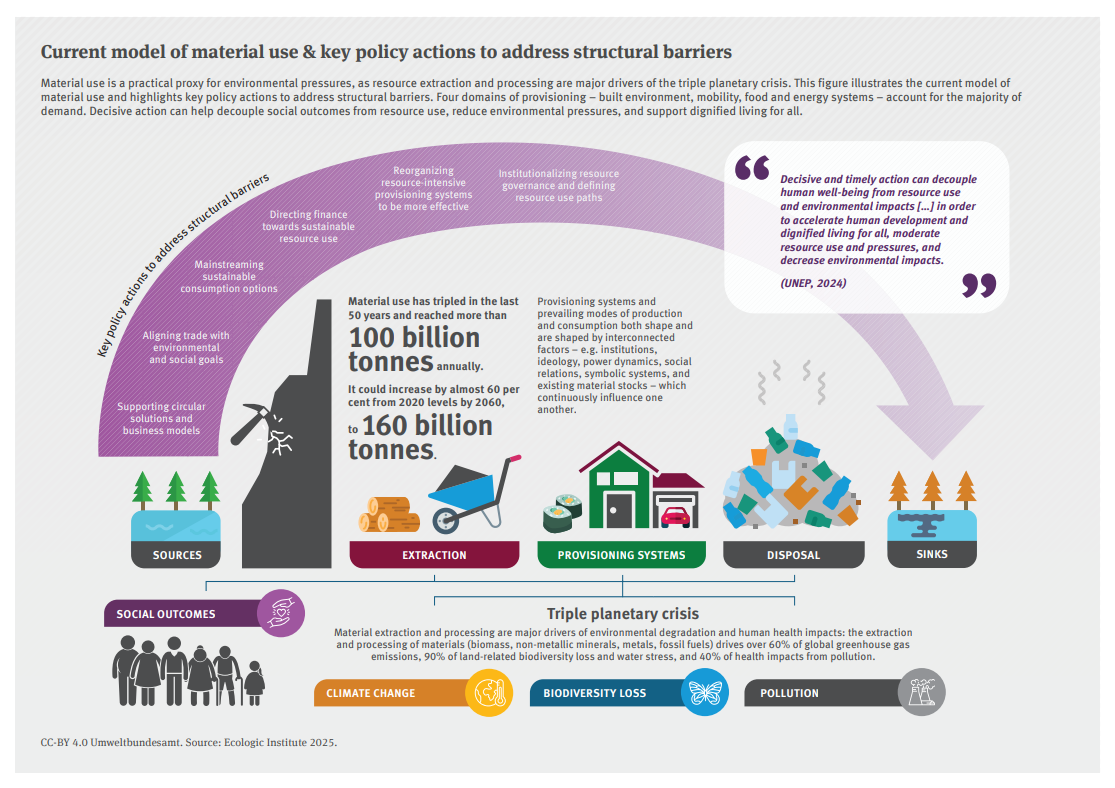
This infographic presents the current model of material use and shows how extraction, production, consumption and disposal drive environmental pressures. It also outlines key policy actions to overcome structural barriers, reduce resource use and decouple human well-being from environmental harm. It is based on the report “Moving from Interconnected Crises to Systemic Solutions. Resource Efficiency, Nature-based Solutions, and Systemic Transformation as Responses to the Complexity of the Triple Planetary Crisis” and highlights concrete pathways for action. The infographic is also included in the accompanying fact sheet under the same title.
This solution-oriented infographic showcases nature-based solutions (NbS) as systemic responses to the triple planetary crisis, illustrating how measures such as wetland restoration, mangrove protection or urban green infrastructure can simultaneously address climate change, biodiversity loss and pollution, while delivering co-benefits for health, resilience and livelihoods.
Humanity has already exceeded six of the nine planetary boundaries, with climate change, biodiversity loss, and pollution pushing the Earth system beyond its safe operating space. Because these boundaries interact through complex feedback loops, surpassing one accelerates pressures on the others, creating cascading effects that amplify environmental degradation. This interconnected dynamic is driving a systemic triple planetary crisis, or polycrisis, that undermines ecological resilience and threatens long-term human well-being. Addressing it requires integrated, cross-sectoral approaches that tackle shared drivers and deliver co-benefits across environmental and socio-economic domains.
Nature-based solutions are central to climate change adaptation. Urban green spaces and waterbodies can reduce heat in cities, for example. How can local authorities implement such measures despite limited resources? This paper presents financing options based on practical examples – from crowdfunding to green bonds – and assesses which ones are suitable and when. It also provides recommendations on how the federal and state governments can provide support.
This study investigates instruments that could generate revenue for international climate finance. Through a mixed-methods approach, including desk research and interviews with 23 experts from diverse professional backgrounds, the study evaluates four proposed levies: a Fossil Fuel Extraction Levy, a Levy on Windfall Fossil Fuel Profits, a Levy on Plastic Polymers, and a Levy on Jet Fuel.
Mediterranean countries share commitments to protect and restore coastal wetlands, but progress is monitored through a range of regional, European and international frameworks. A common evidence base could make these efforts more coherent. A RESTORE4Cs policy brief proposes a harmonised set of indicators to help countries track progress while aligning reporting under the Barcelona Convention with wider biodiversity and climate commitments.