The European Scientific Advisory Board on Climate Change (ESABCC) has published the report “Climate Change Mitigation and Adaptation in the Agri-food Sector – Recommendations for a Coherent EU Policy”. The report calls on the EU to better integrate climate mitigation and adaptation across the entire value chain. Its aim is to safeguard food security, strengthen farmers’ livelihoods and align the agri-food system with the EU’s climate goals.
Nature-based climate adaptation can only be effective if it reaches the people it is meant to serve. Inclusive public communication plays a key role in this process: it helps ensure that nature-based solutions are not only planned and implemented but also understood, accepted and shaped by a wide range of communities. This guide, published by the German Environment Agency, provides practical guidance on how municipalities can design inclusive communication strategies for nature-based climate adaptation.
Nature-based climate adaptation unfolds not only in urban space but also in public perception. Measures such as urban greening, water retention or heat action plans require clear and targeted communication in order to be understood, accepted and supported. A new short guide published by the German Environment Agency outlines how municipalities can use press work strategically to communicate nature-based climate adaptation in a clear and structured way.
What do shaded paths, green roofs and restored waterways have in common? In many cities, they are already part of the urban landscape – yet often remain unnoticed. This guide, published by the German Environment Agency, focuses on these existing measures. It explains how municipalities can use city maps to make nature-based climate adaptation visible, place it in context and communicate it in a transparent and accessible way.
This policy brief examines how current climate-action rewarding mechanisms address – or fail to address – organic farming as a systemic and climate-resilient approach. It analyses existing monetary, regulatory and supportive instruments at EU level, with a particular focus on the Common Agricultural Policy (CAP) and the Carbon Removal and Carbon Farming (CRCF) Regulation.
The toolkit brings together tried-and-tested instruments and organises them along a typical municipal workflow: from initial orientation and planning through to implementation, maintenance, monitoring and evaluation. Local authority departments, planners and other stakeholders will find concise fact sheets outlining each tool, advice on how to apply it at different project stages, as well as links to further resources and practical examples.
This publication provides a quantitative overview of the development and status of environmental crime in Germany between 2013 and 2024, based on data from the police crime statistics ("Polizeiliche Kriminalstatistik") and the Federal Statistical Office's criminal prosecution statistics ("Strafverfolgungsstatistik"). The report provides both an overview of general trends and an in-depth account of individual environmental offences. The report was prepared by a team from Ecologic Institute on behalf of the German Federal Environment Agency.
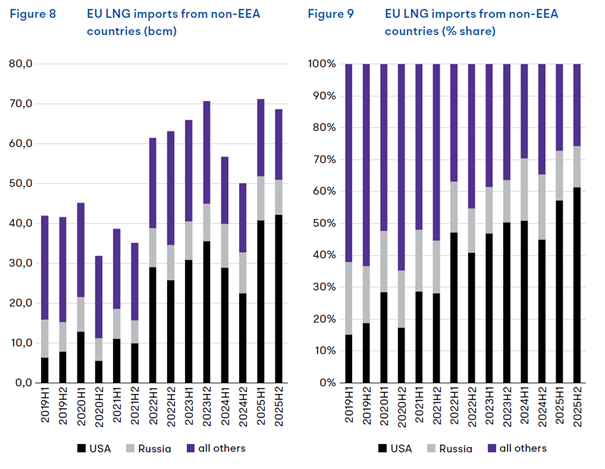
Based on a novel analysis covering the entire European Economic Area (EEA, notably including Norway), this policy brief shows that US gas imports into the EEA sharply surged in 2025. They now account for almost 40% of total EEA gas imports and nearly 60% of LNG imports. This trend exposes Europe to heightened geopolitical pressure, price volatility and the risk of stranded assets.
The aim of the analysis is to assess stormwater management measures not only in terms of their hydraulic performance and costs but also to systematically capture their additional ecological, social and economic benefits.
This policy brief offers recommendations for EU and national policymakers to enable diversified funding for nature restoration. It draws on lessons from four Horizon 2020 projects – MERLIN, REST‑COAST, SUPERB, and WaterLANDS – that together worked across Europe to test how restoration projects can attract broader support and financing.
Two information postcards have been developed for the Market Information Talks for the Organic Sector 2026. The postcards support communication for the dialogue series and draw attention to key challenges along organic value chains in Brandenburg.
This report presents a strategic, evidence-based approach to support the upscaling of freshwater restoration and implementation of Nature-based Solutions across Europe. Central to the approach is the MERLIN Upscaling Workflow, a flexible decision-support tool that uses Europe-wide datasets to identify high-impact restoration areas.
The chapter “International climate finance: institutions in the climate regime” by Dr. Ralph Bodle appears in the Research Handbook on Climate Finance and Investment Law. The volume is part of the Research Handbooks in Climate Law series and was published by Edward Elgar Publishing in 2025.
This report contributes to a better understanding of the economic implications of climate change adaptation across the European Union. Its central objective is to analyse three key dimensions: the costs of adapting to climate change, the costs of inaction, and current levels of adaptation funding. The analysis focuses on three climate-sensitive sectors of strategic importance for the EU economy and society: transport, energy, and agriculture.
This paper examines the penalty provisions in the draft Romanian implementing law proposed by the Romanian government on 22 July 2025. It briefly considers the draft's legislative status, assesses its compliance with EU-MER, and compares it with good practice in Denmark and with Italy's draft law.
This paper examines the penalty provisions in the draft Czech implementing law submitted on 11 November 2025 by the Minister for the Environment to the Prime Minister. It briefly considers the draft's legislative status in light of the political situation following the 3–4 October general election, assesses its compliance with the EU-MER, and compares it with good practice in Denmark and with Italy's draft law.
Myanmar is a global biodiversity hotspot, home to over 570 freshwater fish species and many endemics. Yet its rivers face mounting pressure from pollution, land-use change and declining water quality. This study co-authored by Ecologic Institute's Dr. Benjamin Kupilas offers novel insights into how tropical fish communities respond to these stresses.
After giving a concise overview of the penalty provisions in the EU Methane Regulation (EU-MER), this paper counters the scaremongering narrative promoted by fossil energy groups that the EU-MER creates "unmanageable liability" for EU fossil-fuel importers through fines of up to 20% of annual turnover.
A competitive, clean, and fair EU economy depends on smarter governance practices. This paper proposes eight priority actions for simpler, leaner, and more performance-oriented transition governance in the EU.
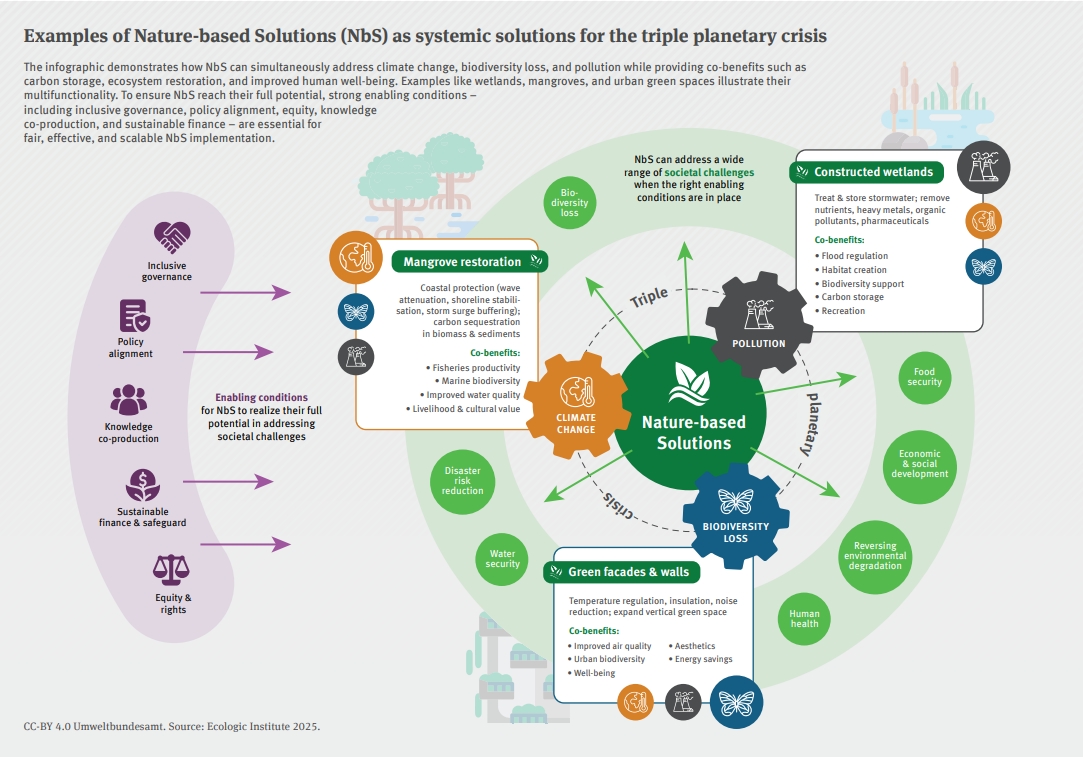
This solution-oriented infographic showcases nature-based solutions (NbS) as systemic responses to the triple planetary crisis, illustrating how measures such as wetland restoration, mangrove protection or urban green infrastructure can simultaneously address climate change, biodiversity loss and pollution, while delivering co-benefits for health, resilience and livelihoods.
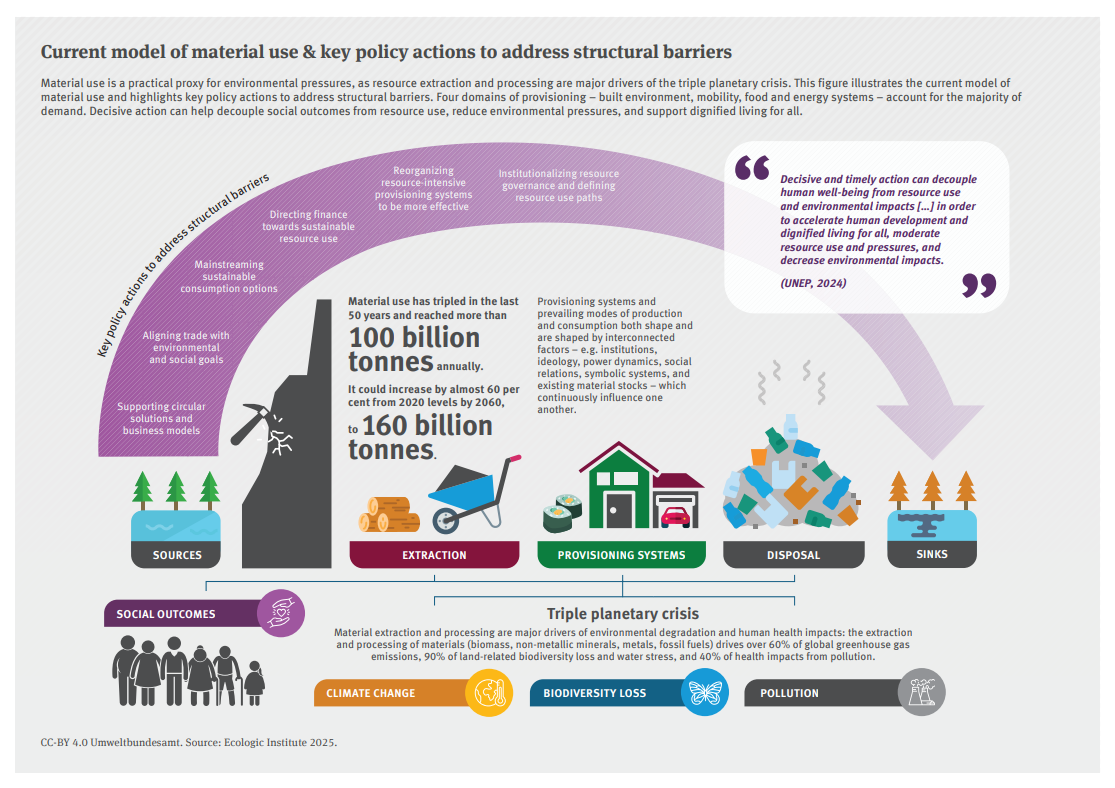
This infographic presents the current model of material use and shows how extraction, production, consumption and disposal drive environmental pressures. It also outlines key policy actions to overcome structural barriers, reduce resource use and decouple human well-being from environmental harm. It is based on the report “Moving from Interconnected Crises to Systemic Solutions. Resource Efficiency, Nature-based Solutions, and Systemic Transformation as Responses to the Complexity of the Triple Planetary Crisis” and highlights concrete pathways for action. The infographic is also included in the accompanying fact sheet under the same title.
Nature-based solutions (NbS) can address multiple dimensions of the triple planetary crisis at once: climate change, biodiversity loss, and environmental pollution, while delivering benefits for people and ecosystems. This infographic, visualises how NbS can function as systemic responses when designed and implemented under the right conditions. It illustrates how measures such as mangrove restoration, constructed wetlands, and urban green infrastructure can simultaneously contribute to climate mitigation and adaptation, strengthen biodiversity, and reduce pollution-related pressures. It also highlights the broader societal challenges that NbS can support, including water and food security, human health, risk reduction, and reversing environmental degradation.
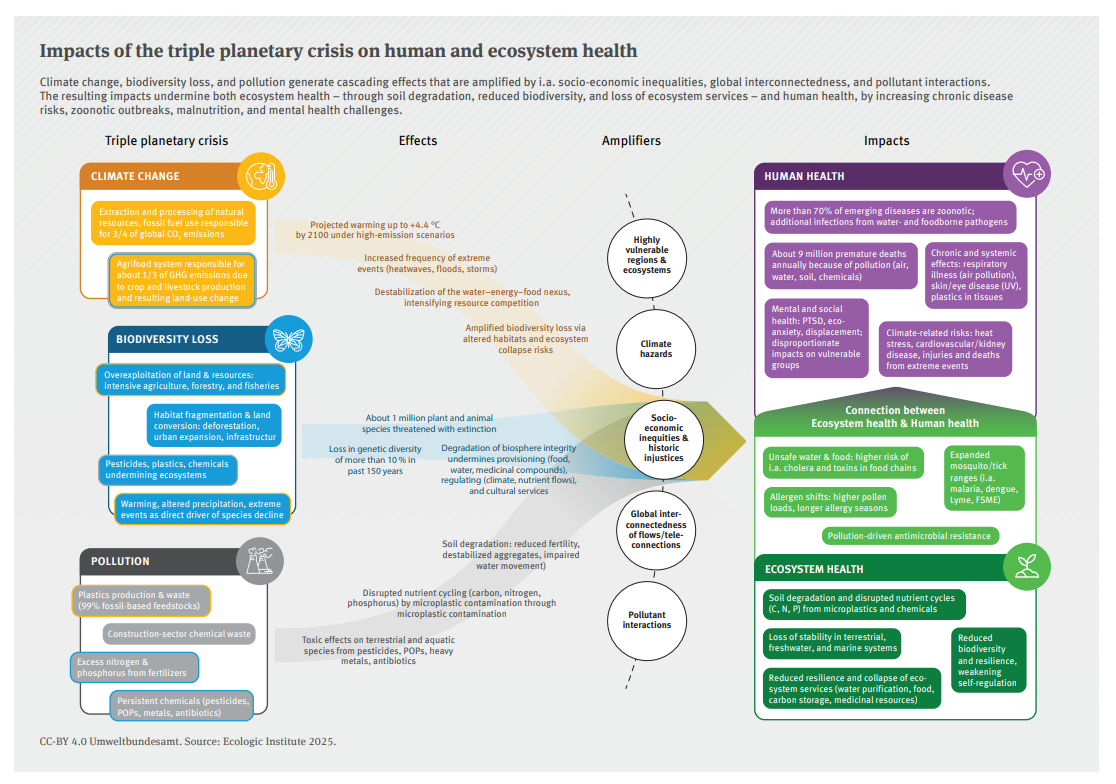
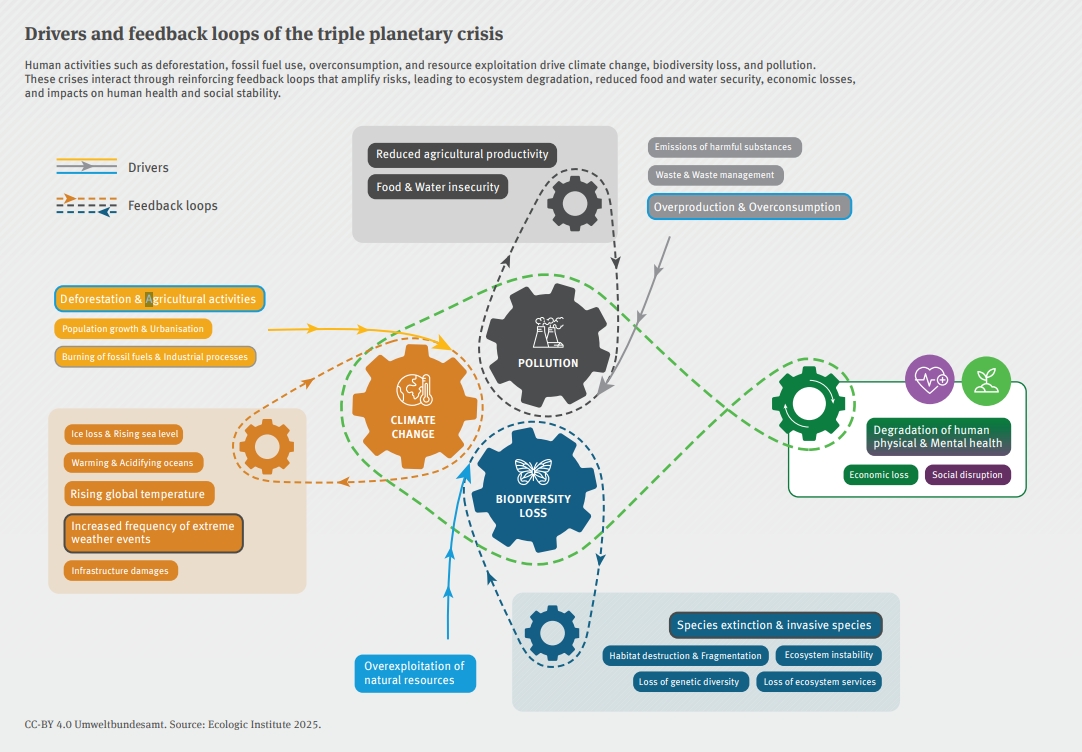
Climate change, biodiversity loss and environmental pollution are deeply interconnected and reinforce one another. This infographic, based on the report "The Interconnected Challenges of Climate Change, Biodiversity Loss and Environmental Pollution: Drivers, Interdependencies and Impacts of the Triple Planetary Crisis", illustrates the main human-driven causes of the triple planetary crisis and the feedback loops that intensify its impacts.
The fact sheet explains why climate change, biodiversity loss and environmental pollution must be understood as a systemically interconnected crisis driven by shared pressures such as resource use, land-use change and structural inequalities. It highlights how direct and indirect drivers interact across sectors and regions, creating reinforcing feedbacks and compounding risks for ecosystems and societies.
Humanity has already exceeded six of the nine planetary boundaries, with climate change, biodiversity loss, and pollution pushing the Earth system beyond its safe operating space. Because these boundaries interact through complex feedback loops, surpassing one accelerates pressures on the others, creating cascading effects that amplify environmental degradation. This interconnected dynamic is driving a systemic triple planetary crisis, or polycrisis, that undermines ecological resilience and threatens long-term human well-being. Addressing it requires integrated, cross-sectoral approaches that tackle shared drivers and deliver co-benefits across environmental and socio-economic domains.
The study was commissioned by the Federal Agency for Nature Conservation (BfN) to support the German Federal Government in reporting on the Action Programme for Natural Climate Protection (ANK). Ecologic Institute led the project and was responsible for analysing the action areas peatlands, near-natural water regimes, marine and coastal ecosystems, wilderness and protected areas, forest ecosystems, research and capacity building, as well as cooperation within the EU and internationally.
This fact sheet summarizes the information contained in the publication Burgos Cuevas et al. (2025): Moving from interconnected crises to systemic solutions. Resource efficiency, nature-based solutions, and systemic transformation as responses to the complexity of the triple planetary crisis. Interim report, Climate Change 83/2025. German Environment Agency: Dessau-Roßlau. https://doi.org/10.60810/openumwelt-8108.
The triple planetary crisis is a systemic challenge, not three separate issues: climate change, biodiversity loss, and pollution reinforce one another through shared drivers and feedback, threatening planetary and human well-being. It is driven by fossil fuel dependence, unsustainable production and consumption, overexploitation of land and resources, and structural inequalities. The analysis concludes that the triple crisis can only be effectively addressed through systemic, cross-sectoral, and justice-oriented approaches. By linking resource governance, NbS, and transformative change, this report highlights how today’s triple crisis can be turned into an opportunity to regenerate ecosystems, reduce inequalities, and build resilient societies within planetary boundaries.
This report, commissioned by the German Federal Agency (UBA), provides a systematic analysis of this triple planetary crisis. It demonstrates why climate change, biodiversity loss, and environmental pollution cannot be understood and tackled in siloes, but instead share common drivers, feedback mechanisms, and cascading effects. The aim of the report is to close knowledge gaps and provide political and scientific actors with an integrated, holistic understanding.
Climate change is exacerbating drought, low water levels, and heavy rainfall in German river basins, posing new challenges for agriculture, forestry, water management, ecosystems, and municipal planning. Against this backdrop, the project KliMaWerk investigated how the landscape water balance can be made climate-resilient through integrated, practical strategies and measures. The KliMaWerk final report summarises the key findings and strategic conclusions.
Nature-based solutions are central to climate change adaptation. Urban green spaces and waterbodies can reduce heat in cities, for example. How can local authorities implement such measures despite limited resources? This paper presents financing options based on practical examples – from crowdfunding to green bonds – and assesses which ones are suitable and when. It also provides recommendations on how the federal and state governments can provide support.
This report highlights the persistent exclusion of commonly excluded stakeholders (CES) – such as marginalised communities, migrants, Indigenous peoples, youth, older adults, and those facing socio-economic vulnerabilities – from the co-creation of nature-based solutions (NbS). Inclusivity is shown to be essential for NbS to be legitimate, effective, and sustainable, yet CES often remain sidelined due to power asymmetries, structural disadvantages, rigid project cycles, and a lack of trust.
The present report discusses criteria that could reasonably be applied to prioritise downstream products for inclusion in CBAM. It examines the significance and suitability of different criteria, as well as the availability and reliability of data to operationalise these criteria.
This guest article by Christoph Heinrich, published in the Table.Forum Biodiversity (Table.Media), outlines the central importance of biological diversity for the functioning of ecosystems and for human livelihoods.
This study investigates instruments that could generate revenue for international climate finance. Through a mixed-methods approach, including desk research and interviews with 23 experts from diverse professional backgrounds, the study evaluates four proposed levies: a Fossil Fuel Extraction Levy, a Levy on Windfall Fossil Fuel Profits, a Levy on Plastic Polymers, and a Levy on Jet Fuel.
This poster summarises key findings from the socio-economic assessment of blue-green infrastructure measures conducted within the AMAREX project. The analysis covers 21 decentralised measures such as infiltration swales, tree pits, and green or retention roofs.